
Opinions
THE OPINIONS IN THIS SECTION WERE WRITTEN BY COMMUNITY MEMBERS AND MANY WERE FIRST PUBLISHED IN THE FOUNTAIN HILLS TIMES INDEPENDENT.
THE PAPER HAS BEEN UNFAIRLY ATTACKED BY ROT AND ITS SUPPORTERS AS “PARTISAN” AND HAS LOST SUBSCRIPTIONS AS A RESULT.
PLEASE CONSIDER SUBSCRIBING TO OUR COMMUNITY NEWSPAPER. DEMOCRACY DIES IN INFORMATION SILOS.
https://www.fhtimes.com/
An Emboldened Friedel is Now Gaslighting us From the Dais
Gerry Friedel is no stranger to gaslighting. During his 18 months in office, Friedel has engaged in gaslighting on issues ranging from the reason he ordered the press table removed from the council chambers to the reason the River of Time Museum is facing eviction. But during the May 5, 2026, Town Council meeting Friedel reached a new low when he publicly denied making a statement residents can still read on the pages of the Fountain Hills Times Independent and which he affirmed as true while testifying under oath.
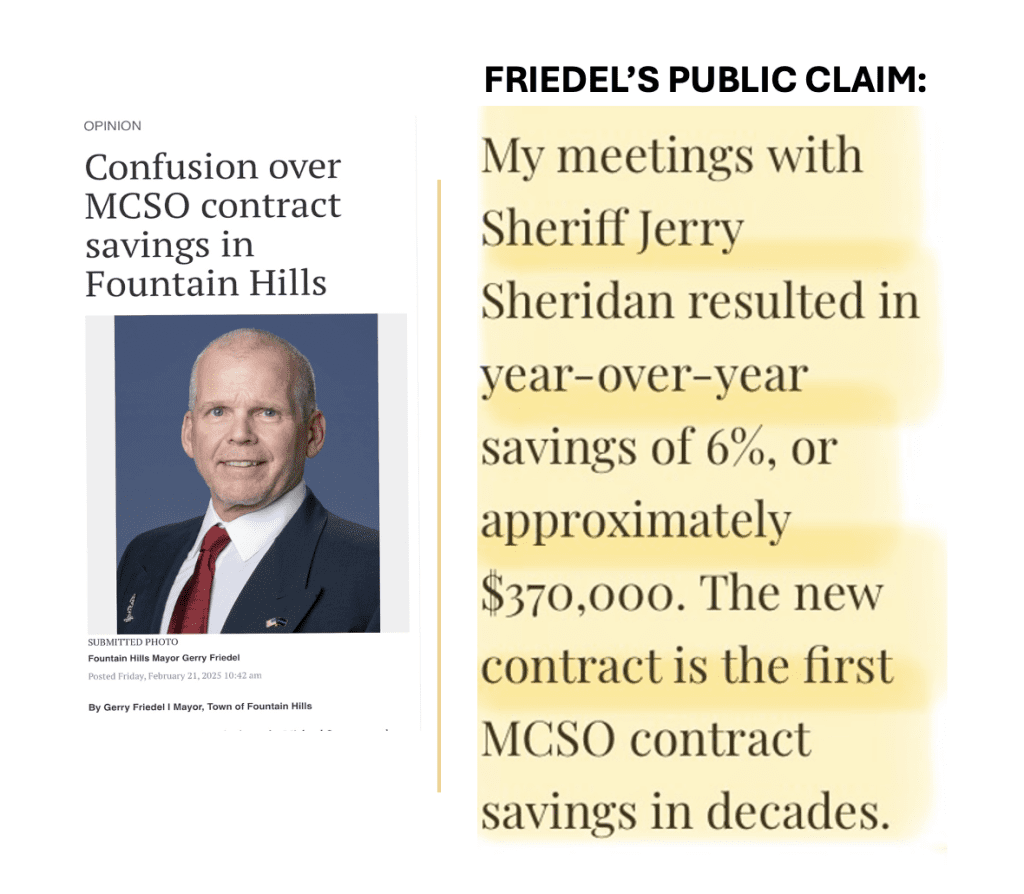
During the Call to the Public at the May 5 meeting, a resident expressed her disappointment in Friedel’s veracity, citing as an example his false claim that meetings he held with MCSO Sheriff Gerry Sheridan resulted in a 6 percent savings to taxpayers.
In response Friedel said that he never claimed that his meetings with Sheridan resulted in the reduction in the contract price. According to Friedel’s recently articulated alternate facts, the Town issued a press release and “All we reported was that as the result of what he told us in the meeting, the town received a 6.01 percent reduction in the sheriff’s contract.” Friedel went on to admonish the resident by saying you “[s]hould really have the facts straight before you accuse.”
The resident did have her facts straight and it is Friedel who is distorting the facts.
The February 6, 2025, press release Friedel referred to included the following statement attributed to him:
“I am pleased to announce that the MCSO contract for Fountain Hills residents will go down roughly 6%!” said Mayor Gerry Friedel. “A short time after being sworn in, Sheriff Jerry Sheridan and I met. I expressed the concerns I had with the contract and to say he listened would be an understatement!”
Friedel’s statement in the press release was designed and intended to lead residents to believe that after he expressed his concerns about the cost of the services being provided by MCSO, Sheridan agreed to a 6 percent reduction in those costs.
However, in a subsequent letter to the editor of the Fountain Hills Times, Friedel went further by taking direct credit for the reduction as follows: “My meetings with Sheriff Jerry Sheridan resulted in year-over-year savings of 6 percent, or approximately $370,000. The new contract is the first MCSO contract savings in decades.”
That claim was proven to be a lie when correspondence from the MCSO, produced in response to a records request, established that the 6 percent reduction in the cost of MCSO’s services was unrelated to any meeting he held with Sheridan, but the result of an automatic adjustment attributable to reduced personnel costs.
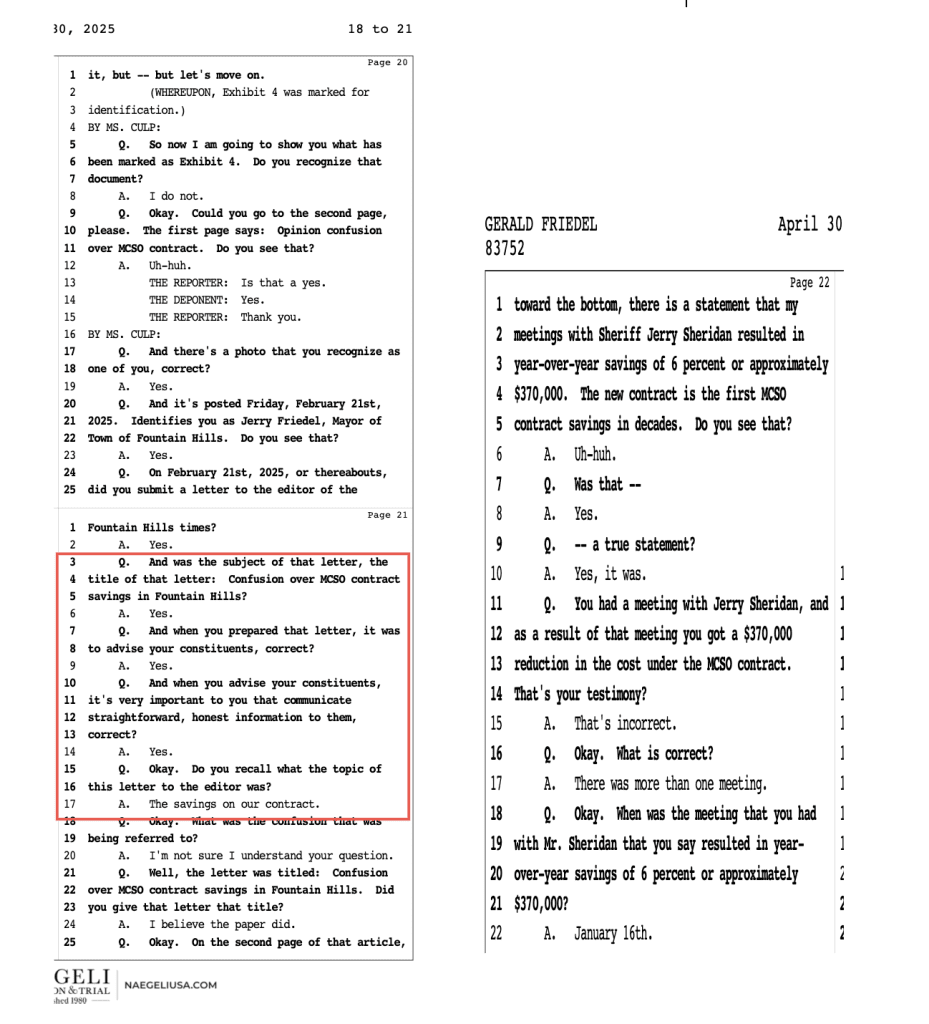
Friedel’s recent assertion that he did not take personal credit for the “new contract” with MCSO is also inconsistent with testimony he provided under oath last year.
When asked if the statement that his meetings with Jerry Sheridan resulted in year-over-year savings of 6 percent was true, Friedel replied “Yes.” Friedel went on to testify that he had two meetings with Sheridan and it was the second meeting, held on January 16, 2025, that resulted in the 6 percent savings.
Friedel is operating under the belief that he can lie to residents with impunity. During a public, recorded meeting while sitting behind his “Mayor” plaque, Friedel denied ever making a statement that is indelibly recorded in a letter published under his name in the Fountain Hills Times. He denied making a statement that he swore, under penalty of perjury, was true.
Friedel’s confidence that no consequences will flow from his deliberate deceptions is understandable. Friedel’s lies will never be revealed to the thousands of residents who get their information from private social media pages, where members are screened based on their political party affiliations and banned if they say anything to contradict or question him.
Filing a formal ethics complaint based on Friedel’s most recent lie is not an option. Last year, his false claim that his meeting with Sheridan resulted in a “new contract” was the subject of a formal ethics complaint. Following an initial review by Town Attorney Aaron Arnson, that ethics complaint was found to have merit and referred to outside council for review. Friedel and his supporters on the council responded by illegally dismissing the pending ethics complaint and deleting the provisions empowering residents to file ethics complaints from the Rules of Procedure.
Friedel will not be held accountable for the lies he tells in private meetings, online or from the dais. The only hope we have of restoring integrity to our town government is to take away the ROT majority’s control by electing candidates who respect the public’s right to be told the truth.
A Tale of Two Standards: River of Time Museum, Friedel
The ROT majority invokes the Arizona Constitution to justify the ouster of the River of Time Museum, but ignores it to protect Gerry Friedel.
In January the members of the board of directors of the River of Time Museum were advised that they had eight months to come up with $75,000 or be prepared to vacate the space they and their predecessors had lovingly curated and maintained for decades.
The board was aware that on August 1, 2026, its 25-year lease with the Town was scheduled to expire, but they could not have anticipated that the Friedel administration would increase the rent they would be charged by 900 percent.
In a subsequent letter to the board, explaining its determination that the Museum must “pay or go,” the Town relied on the “Gift Clause” found in Article 9, Section 7 of the Arizona Constitution, that states: “Neither the state, nor any county, city, town, municipality, or other subdivision of the state shall ever give or loan its credit in the aid of, or make any donation or grant, by subsidy or otherwise, to any individual, association, or corporation….”
The Gift Clause as interpreted and applied by the Arizona Supreme Court does not support the Town’s demand that the Museum pay the full fair market value for a lease of the property. A lease payment for less than the fair market value is valid if it serves a public purpose and the benefit received by the public is not so inequitable and unreasonable that it amounts to an abuse of discretion.
The Gift Clause is designed and intended to prevent the use or diversion of public funds or resources where the public receives little or no real benefit. How can the Friedel administration credibly contend that for the past decades the Museum has provided no benefit to the residents of Fountain Hills? Is it the administration’s position that prior town councils violated the Constitution by not demanding that the Museum pay the full market value for the use of the space? Or did the new Town Attorney, aware that the administration coveted this prime space steps away from the Dark Sky Discovery Center, come up the idea of invoking the Gift Clause as a justification for constructively evicting the Museum?
The Gift Clause prohibits below market rental transactions only where the government effectively gifts space it owns without receiving a corresponding public benefit in return. The public benefit that can be provided in lieu of dollars includes intangibles like providing cultural enrichment, educational opportunities, and supporting community identity.

The Museum is not a commercial tenant. It is a cultural institution dedicated to preserving the history of Fountain Hills, attracting visitors, and providing educational opportunities for our residents and our schools. These benefits may be difficult to quantify but they are real and must be taken into account. The fact that the Town issued its notice without giving any consideration to these benefits indicates that its decision was motivated by a desire to take over the space – not by any concern that in continuing to subsidize the museum it was violating the Gift Clause.
This interpretation of the Friedel administration’s true motivation for ousting the Museum is supported by its similarly self-serving decision to use public funds to pay for Friedel’s defense and release him from personal liability in the personal liability action that was brought against him.
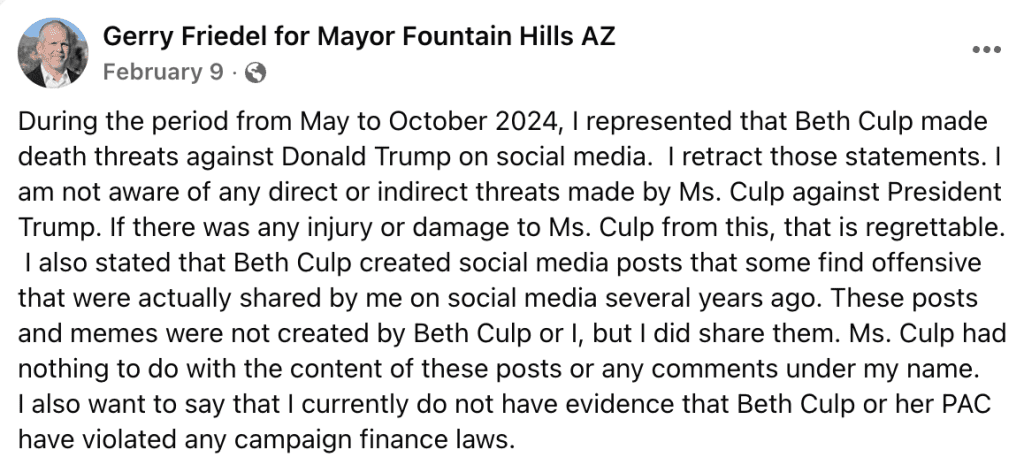
The lawsuit, brought against Friedel solely in his individual capacity, was based on social media posts, published on his personal Facebook pages. In these posts Friedel falsely and repeatedly accused a resident of committing a federal crime. Friedel also falsely accused the resident of impersonating him on social media and publishing crude and offensive posts under his name.
The Town had no obligation or legal right to use public funds to defend or indemnify Friedel in that action. No benefit was received by the public when the Town provided its mayor with the gift of a defense and a release from personal liability.
The free ride given to Gerry Friedel, and not the continued support of a beloved institution, is the violation of the Gift Clause that our Town Council should be concerned with.
Arrogance or Ignorance?
Why would Gerry Friedel falsely accuse Ginny Dickey and Peggy McMahon of committing a federal crime months after the Town bailed him out for doing the same thing?
One would have hoped that Friedel would have learned from recent experience that falsely accusing someone of committing a crime is likely to lead to a lawsuit. But only months after the Town, at taxpayer expense, settled the lawsuit that resulted from Friedel falsely accusing a resident of threatening to kill Donald Trump, he has done it again. This time by publicly accusing former Mayor Ginny Dickey and Councilwoman Peggy McMahon of violating the Public Officials Bribery statute.
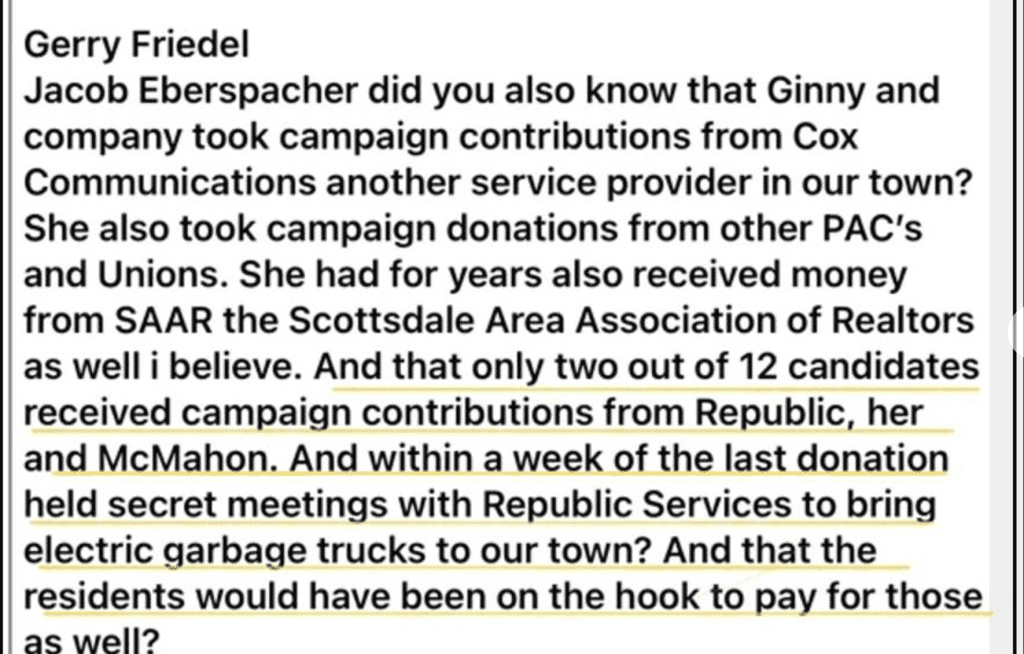
In a recent post, on an increasingly notorious private Facebook page, Friedel falsely accused Dickey and McMahon of taking campaign contributions from Republic Services. In that post Friedel attempted to justify the ROT majority’s decision to replace Republic Services as the Town’s trash hauler by falsely accusing it of participating in a “pay to play” scheme. An accusation he knew to be false.
Friedel is not unfamiliar with the rules regulating campaign finance and was certainly aware that Republic Services could not make donations to the Dickey or McMahon campaigns. Friedel was also aware the donations were made by the Republic Services Employees Better Government PAC, not Republic Services.
The Better Government PAC receives no funds from Republic Services. The PAC is funded by the personal contributions of drivers, loaders, sanitation workers and administrators. The PAC contributes to campaigns based on the employees’ assessment of a candidate’s stance on issues, like employee safety and labor regulation, that affect them.
Friedel went beyond falsely accusing Republic Services of making illegal campaign contributions, he also accused Republic Services, Dickey and McMahon of corruption practices by claiming that “…within a week of the last donation [Dickey and McMahon] held secret meetings with Republic Services to bring electric garbage trucks to our town? (sic) And the residents would have been on the hook to pay for those as well? (sic)”
This is not the first time that Friedel has suggested that, as mayor, Ginny Dickey was involved in a conspiracy with Republic Services. In 2024, as part of a coordinated smear campaign, Allen Skillicorn and Friedel both suggested that Dickey had agreed with Republic Services to introduce “woke” garbage trucks to the Town’s trash collection service.
Both Friedel and Skillicorn, as members of the Town Council, knew that this statement was false. As mayor, Dickey lacked the authority to make a unilateral decision that would affect the manner in which trash hauling and recycling services were provided to residents.
In his recent post that went beyond suggesting that Mayor Dickey was conspiring with Republic Services, he accused her and Peggy McMahon of accepting a bribe by claiming that within a week of accepting the last donation secret meetings were held to “bring electric garbage trucks to Fountain Hills” that “residents would have been on the hook to pay for.”
In Arizona, falsely accusing someone of a crime involving moral turpitude (dishonesty, fraud, or corruption) is defamation per se. Friedel claimed that Republic Services paid money to Dickey and McMahon to secure a taxpayer-funded contract to bring electric trucks to Fountain Hills, conduct that would violate 18 U.S.C. § 201(b), the Bribery of Public Officials statute.
At the time he published his “pay to play” accusation, Friedel knew it was based on lies. There were no “secret meetings” between representatives of Republic Services, Ginny Dickey and Peggy McMahon where bringing electric trucks to Fountain Hills at taxpayer expense was discussed.
There was a meeting, held in early April 2024, that Mayor Dickey did not attend, where Republic Services planned conversion of a portion of its fleet to electric vehicles was discussed. That meeting was attended by: Town Manager, Rachael Goodwin; Angelea Espiritu, Goodwin’s Executive Assistant; the Public Works Director, Justin Weldy; and Peggy McMahon.
The meeting had been scheduled to allow Republic Services to discuss its initiative, first announced in 2023, to convert half of its fleet to “Fully Integrated Electric Recycling and Waste Vehicles” by 2028. It was in the Town’s interest to learn about Republic’s introduction of lighter, fuel efficient, lower maintenance vehicles that Republic Services believed would reduce its operating expenses, that also had the potential to impact what residents paid for trash collection and recycling services.
At the time Friedel published his defamatory post, he knew that the purpose of the meeting was to share information about the initiative, not to put the public “on the hook” to pay for new trucks.
Defamatory statements made with knowledge that they are false is evidence of “actual malice.” Where “actual malice” is present Friedel cannot raise the First Amendment as a defense, even though Dickey and McMahon are public figures. In addition, a determination that the statements were made maliciously would entitle Ginny Dickey and Peggy McMahon to an award of punitive damages.
Friedel’s defamatory accusations are still posted on Facebook. He would be well advised to delete those accusations and promptly post another public retraction. Taxpayers will not pay to defend and settle a second lawsuit resulting from Friedel’s vindictive recklessness.
Creepy, Phony, & Now a Proven Liar: We Don’t Need Another Agent of Chaos
Residents appear to have differing opinions on the question of whether Ben Larrabee is the creepiest candidate in the Town’s history, or the phoniest.
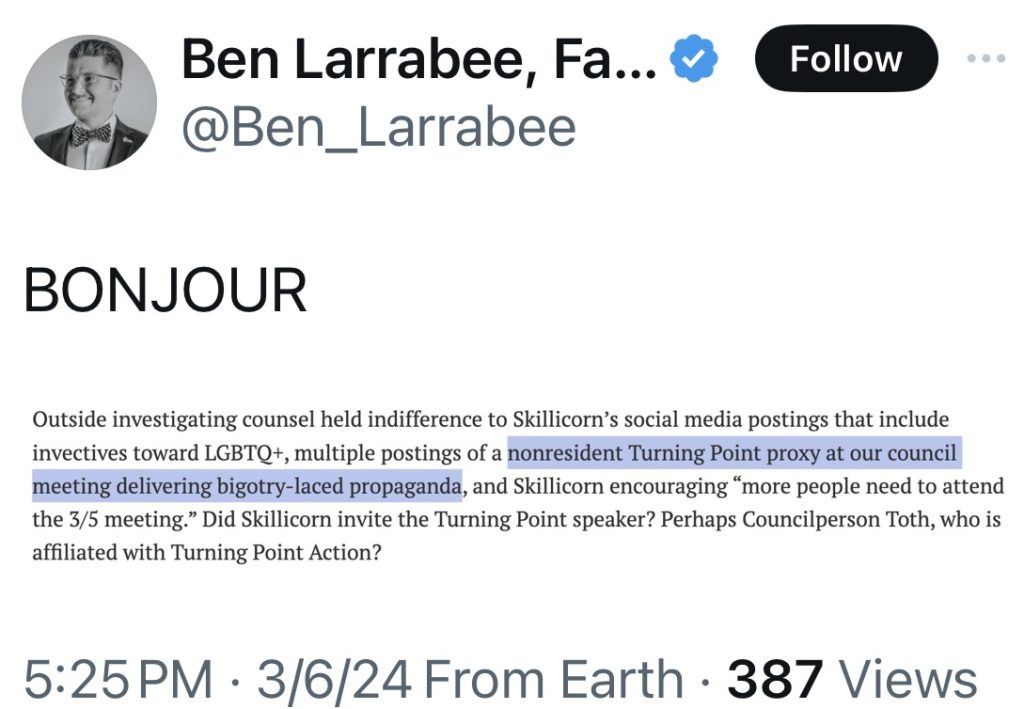
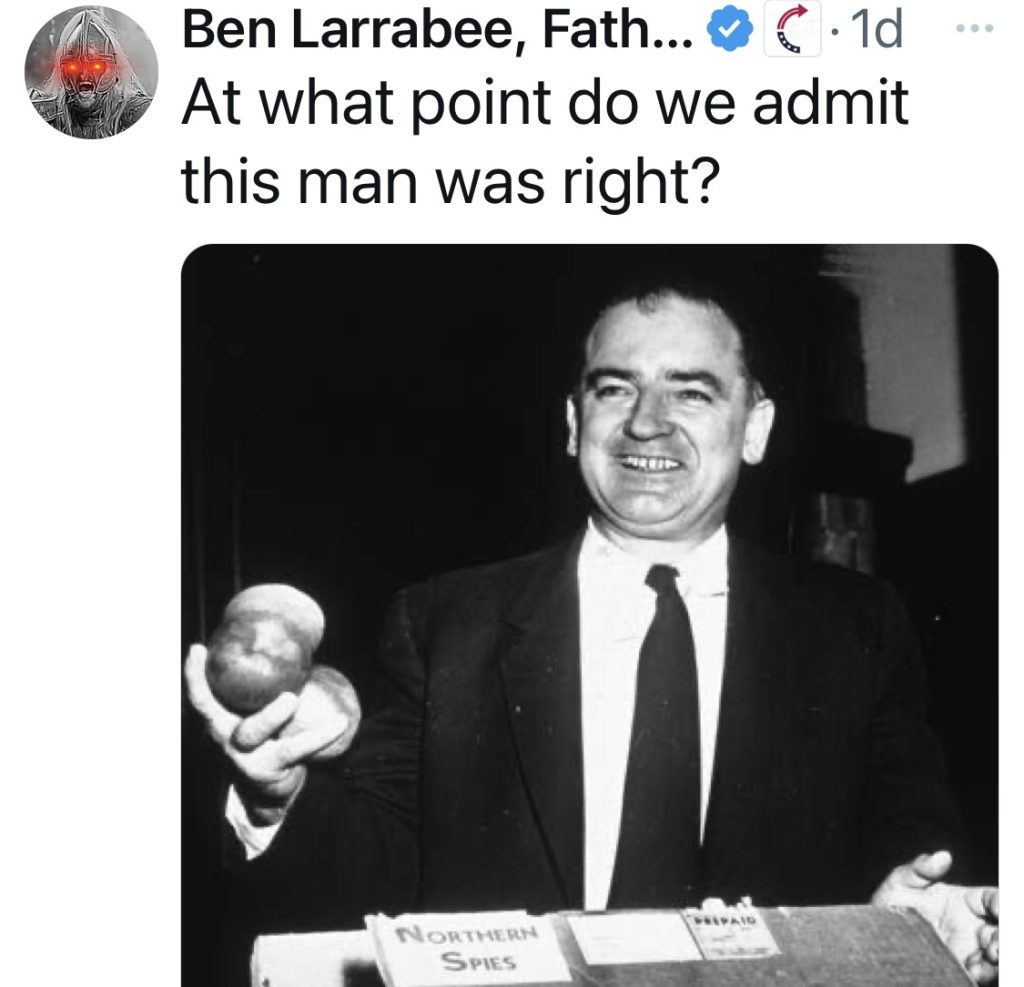
Larrabee is unquestionably creepy. The red-eyed demon he used as his profile picture (before he announced his candidacy) is unquestionably creepy. His job for Charlie Kirk’s Turning Point Action that requires him to share his obsession with transgender children with town councils and school boards is also creepy, as is his need to publicly boast about his toxic masculinity.
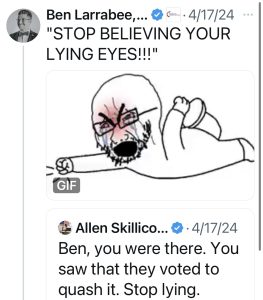
But there is also a case to be made that he is the phoniest candidate in the Town’s history: Strutting through the audience at a Republican Club meeting, thumbs in his pockets, wearing a way too big cowboy hat that keeps falling over his eyes,…the way he opens his town council presentations with the phrase, “I rise to…” and of course, there is that goofy red bow tie.
But we should not allow ourselves to get too distracted by Larrabee’s off-putting character traits. This strange man wants to serve on our town council and is riding on Gerry Friedel’s tattered coattails and ROT’s mayhem-first campaign tactics to achieve that goal. At this moment we need to focus on another of Larrabee’s character traits: he is an inveterate and unapologetic liar.
In a recent post, still to be found on his campaign page, Larrabee claimed that “during the years that Democrats ran the council, NOTHING was saved” to replace the lake liner.” Larrabee also claimed that under “new leadership” the Town had saved “nearly $7 million.”
Both claims are outright lies. Registered Democrats controlled the council for a two-year period from 2020 to 2022. It was during this period that the Fountain Hills Town Council recognized the need to earmark funds to be held in the capital reserve for the replacement of the lake liner. As a result, as of today, approximately $6.7 million has been set aside for the replacement of the lake liner. Of this total, $800,000 (less than 12 percent) of the “nearly $7 million” was set aside in budgets approved by the “new leadership.”
Through his lies Larrabee has revealed himself to be another “agent of chaos” who, like his role model, Allen Skillicorn, purports to be a Christian, but foments lies to create ill-will, division, and resentment. Having rid ourselves of one chaos agent. why would we ever elect another?
Why Did Ben & Gerry Lie About the Funding For The Lake Liner?
In the opening days of the campaign, Town Council candidate Ben Larrabee and mayoral candidate Gerry Friedel appear to be intent on supporting their candidacy by inciting anger and fueling toxic partisanship with lies.
In a recent post, Larrabee claims that “during the years that Democrats ran the council, NOTHING was saved” to replace the
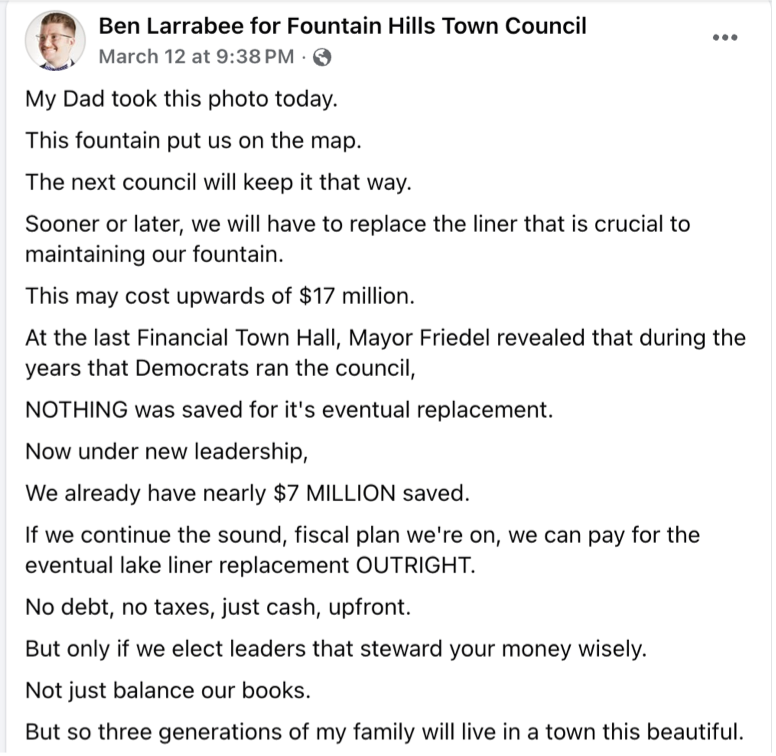
Fountain Hills Park Lake liner. Larrabee attributes this lie to Gerry Friedel, who reportedly “revealed” this fictitious failure on the part of Mayor Dickey’s administration, during the March 24 meeting on the Capital Improvement Plan (CIP).
Larrabee made a major mistake by adopting Friedel’s lie as the opening salvo to his campaign because it is so easily disprovable.
 The fact is that during the past two decades, registered Democrats held a majority on the Fountain Hills Town Council for only two years, December 2020-December 2022, during Ginny Dickey’s second term as mayor.
The fact is that during the two-year period, when Dickey was mayor and registered Democrats held a four-person majority, the Town Council enacted Resolution 2021-13, establishing the budget for the 2021-2022 fiscal year and formalizing the systemic transfer of funds into the capital reserve, identifying the lake liner as a primary long-term infrastructure project.
The fact is that beginning with the 2022 budget cycle and ending with the 2026 budget cycle, successive Town Councils (composed of registered Republicans, Democrats, and Independents) set aside approximately $5.5 million for the replacement of the lake liner. That’s more than a million dollars a year, roughly the same amount set aside under the first budget approved under the “new leadership.”
In his post Larrabee wasn’t content with one outright lie. Mirroring Friedel’s finely honed practice of taking credit for the actions and foresight of prior administrations, Larrabee claimed that “We already have saved nearly $7 million.”
If, by “we” Larrabee is referring to the Friedel administration, that statement is also patently false. As noted above, the first budget submitted by the “new leadership” was for the 2026 fiscal year, which ends in July. During the current fiscal year, approximately $1 million dollars was earmarked for the replacement of the lake liner.
Voters should not be distracted by this manufactured dispute over funding. Funding is not the only concern with the lake liner replacement. There are significant logistical considerations. Sales tax revenue generated by tourists will almost certainly decrease during the months the fountain is out of service. Planning to reduce the down time is essential to the Town’s economic well-being.
During Mayor Dickey’s term in office the Town Council adopted the 2022 Strategic Plan and the accompanying 10-year Capital Improvement Program that functions as the legal “placeholder” for the lake liner replacement project. Through this program the Town tracks the effect of inflation on the anticipated cost of the project (which has increased from $8 million to approximately $17 million).
In addition, during Mayor Dickey’s administration, the Town implemented a “Joint Work-Study” strategy with the Fountain Hills Sanitary District, the body charged with managing the use and treatment of the 100 million gallons of “reclaimed water” that fills the lake and flows through the fountain. The work-study group has been tasked with the responsibility for formulating a workable plan for draining and refilling the lake.
Since the major repair of the lake liner 25 years ago, Town Councils have been aware of the extraordinary expense and disruption associated with the replacement of the lake liner. Given the formidable budgetary challenges, over the past five years the Town Council has made significant strides in preparing for both the expense and the disruption. In the recent CIP meeting Fountain Hills CFO Paul Soldinger noted that the funds set aside were nearing the point where the Town could hire specialized engineers to begin drafting the replacement plan.
However, without regard to advance planning or the total amount set aside there is one obstacle that must be addressed by the Town Council: “the expenditure limit.”
The expenditure limit is the constitutional cap that controls how much an Arizona town or city can spend each year. The expenditure limit is established by reference to the “base limit,” a term used in Article IX, §20, of the Arizona Constitution’s expenditure limitation law. The “base limit” is the starting point for calculating how much a town or city will be allowed to spend from local revenue it collects.
The $4,100,000 “base limit” for Fountain Hill was established in the 1980s, before the town was incorporated and when the population was less than 3,000. Although the Town’s base limit is adjusted each year based on population and inflation, it remains disproportionately low compared to its current needs and the expense associated with infrastructure maintenance and improvement.
If future Town Councils continue to set aside more than $1million a year for the next 10-15 years and have the necessary cash in hand, they could not simply withdraw the funds and pay for replacement, without exceeding the expenditure limit. The limit doesn’t prevent the town from saving money, but it could prevent it from spending a large lump sum in a single year unless one of the following is put in place before that time:
The “Home Rule” option – with voter support, the Town would be allowed to set its own expenditure limit for a limited period of time;
The Voter-Approved Override option – either a “Permanent Base Adjustment” or a one-time override specifically for the lake liner project; or
The Voter-Approved Financing option – essentially a bond to pay for the lake liner.
During the recent CIP meeting the councilmembers appeared to be leaning toward the Home Rule option. But without regard to the option selected the Town Council will need broad community support to address the challenges that lie ahead.
Which leads us to the question we opened with. In Fountain Hills more than 50 percent of the voters are registered Democrats or Independents. Why, when nonpartisan support for the lake liner project is essential, would Ben and Gerry lie about its funding? Why would they invoke this “us versus them” campaign tactic on an issue so critical to our Town’s future? Are they attempting to deflect the criticism they anticipate receiving from ROT’s supporters when they are asked to vote in favor of one of the spending options?
A true leader would recognize that the public interest in thoughtful, truthful governance should always take precedence over partisan gamesmanship, whether it involves assessing blame for something that did not happen or taking credit for something you did not do. But then, look at Ben and Gerry. Are they true leaders?
Friedel and His Personal Attorney Jennifer Wright are Teeing Up Even More Litigation for Us to Pay for
With all of the Notices of Claim and Open Meeting Law complaints pending against the Town of Fountain Hills arising out of the unconstitutional acts of the Town Council, the Park Place debacle, and Jennifer Wright’s ineptitude, you would think that the last thing she and Gerry Friedel would be looking for is more litigation. And yet, they appear to be doing just that. On March 10, Wright, who appears to be as clueless about intellectual property law as she is about municipal governance, issued a “cease and desist” letter, threatening to sue Council candidates for their purported unlawful use of the Town seal and logo in their campaigns.
In that letter, Wright warned candidates that if they use an image that is “substantially similar” to either the Town’s seal or logo, “their continued use on campaign materials may result in legal action.”
Both the Town seal and logo incorporate graphic images of the Town’s iconic fountain. Currently, two candidates for Town Council, Ben Larrabee and Catherine Mirick, have incorporated graphic images of a fountain into their campaign ads. Neither of these images could be confused with the Town Seal or the Town logo. But the Council candidates are not the target.

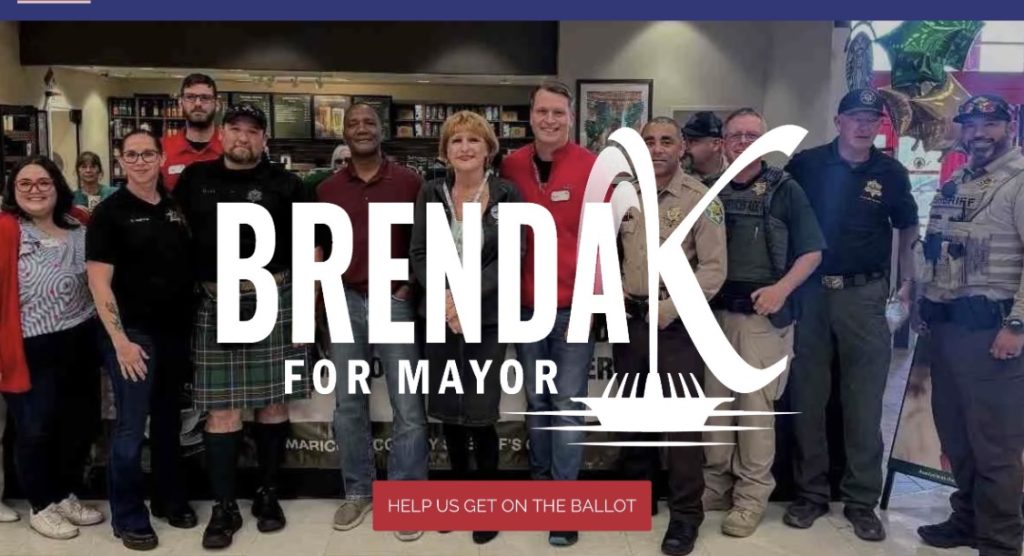
With this “shot across the bow,” Friedel and Wright hope to intimidate Brenda Kaliviankis, Friedel’s opponent, with the threat of litigation that would generate negative publicity for her campaign and force her to incur the cost of revising and reissuing her campaign ads and literature.
The Kalivianakis logo bears no similarity to the one-dimensional Town seal. The Town logo is a stylized, multicolored graphic featuring a sun and mountains behind the silhouette of a fountain. The Kalivianakis logo uses variations of red, white, and blue and does not include the sun or the mountains. The logo does, however, incorporate a minimalist outline of the base of the fountain like that found in the Town’s logo, but with a significant difference in the spray, which in the Kalivianakis logo spills to form the letter ”K.”
The town can trademark its specific artistic rendition of the fountain, but to succeed in an infringement claim the replication must be exact. More importantly, trademark law is designed abd intended to prevent”consumer confusion.” Here, to prevail the Town would need to prove that a reasonable voter looking at the Kalivianakis logo would believe that the Town is officially endorsing her candidacy. Is that likely?
The First Amendment prohibits public bodies and government officials from using trademark law to suppress the speech of political challengers. This act of sending a cease-and-desist letter to the mayor’s opponent during a campaign is likely to be viewed by a court as a strategic move designed to further Friedel’s political goals by forcing his opponent to spend money on new signs and flyers and create negative publicity for her. Think, “Fountain Hills sues Kalivianakis for stealing the Town’s logo”!
This strategy is likely to backfire on both Wright and Friedel by again, casting the spotlight on their cozy relationship . The public is not likely to look favorably on the use of public funds to pursue and intimidate the mayor’s political rival. To do so would violate A.R.S. § 9-500.14, which prohibits the use of Town resources (including staff time) to influence the outcome of an election.
If she pursues this matter Wrightis also inviting an ethics complaint. As a sitting councilwoman, Kalivianakis is a “constituent member” of Wright’s client, the Town of Fountain Hills. Threatening litigation against a councilmember, to benefit a political ally, creates a significant ethical conflict.
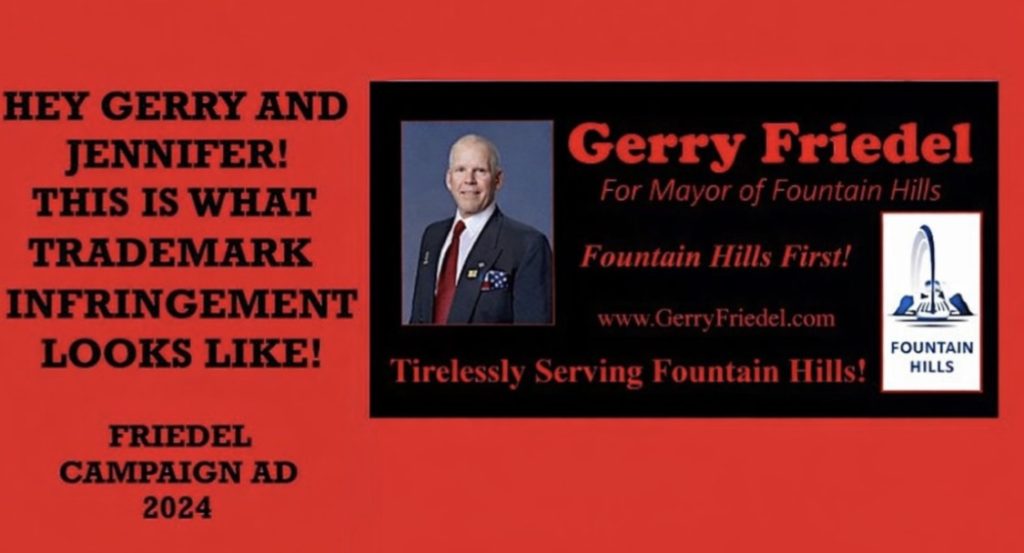
Could the Town succeed in an infringement claim against Kalivianakis? Probably not. A court is not likely to find that the Kalivianakis logo would lead anyone to believe that the Town of Fountain Hills is backing her bid to succeed Friedel.
But without regard to the merits of the trademark infringement claim, the question residents should be asking ask is: “How would the threatened litigation serve our interests?”
Litigation brought against Kalivianakis is likely to be met by a counterclaim against Friedel and the Town. In all likelihood Kalivianakis has personal liability coverage that would pay for her legal defense. In contrast, the amount paid to retain trademark counsel to issue a formal opinion, draft a complaint, and pursue litigation would come directly out of the Town’s budget: our tax dollars.
Will Friedel and Wright stand down? Probably not. But if they cared more about the interests of residents than they do about Friedel’s reelection, they would.
Turning Point Targets April 7th SRP Board Elections
Most Valley residents know Salt River Project (SRP) as the provider that keeps the water running and the lights on. SRP serves about 1.1 million electricity customers and provides water to around 2.5 million residents in the Phoenix area. Fountain Hills is included in these electricity and water service groups. But behind those everyday services are two powerful organizations that shape the region’s water and energy future.

Formed in 1903, the Salt River Valley Water Users’ Association—“the Association”—is a private water corporation managing supplies for more than 2 million people. Its partner, the Salt River Project Agricultural Improvement and Power District—“the District”—was created in 1937 as a publicly governed utility district that now delivers electricity across the Valley. Each has its own board, and every other year eligible landowners vote to elect the SRP president, vice president, board members, and council members to four-year terms.
Turning Point USA is conducting an aggressive campaign to influence those elections. The conservative advocacy group has pledged to “out-register Democrats ten to one” and has branded clean-energy and water-conservation advocates as “radical environmentalists” who will, in their words, “raise utility rates.”
Since mid-2025, Turning Point canvassers have been targeting voters across SRP’s East Valley territory—a key conservative base. On social media, the group is urging supporters to defeat what it calls “Green New Deal extremists” and elect “freedom-minded leadership.” If their endorsed candidates win seats on SRP’s water and power boards, policy could shift sharply—favoring more stored water redirected for urban development while opposing initiatives that preserve river flows for habitat, recreation, or downstream water quality.
On the power side, a Turning Point majority would likely push back against clean energy and sustainability investments. Despite the consequences, SRP board elections often go unnoticed. Only landowning customers within SRP boundaries can vote, a rule that keeps turnout low and limits participation. To check if you’re eligible, type your address into SRP’s voting district map. If you are eligible, learn more about how to cast your ballot for the April 7, 2026 election here.
For information on environmentally focused candidates running for both boards, visit srpcleanenergy.org. With SRP’s leadership shaping the Valley’s water reserves and energy future, these elections carry real stakes. If you have a vote, this is not the year to sit out.
Friedel: It’s a “Privilege” for Residents to Speak in My Town Council Chambers, Not a Right
Listen to his tone, focus on his expression, assess his demeanor. Is THIS a leader, or a tyrant who uses the power of the position to silence his critics?
When Fountain Hills Mayor Gerry Friedel scowled and squinted downward — unwilling to look his audience in the eyes as he unleashed his wrath in the form of “The Call to the Public is not a right, but a privilege” — he wasn’t just offering a careless remark during the Feb. 3 Town Council meeting. He was revealing his governing philosophy.
That statement is a microcosm of a temperamental mayor who views public participation not as a cornerstone of democracy, but as something to be granted, managed, and withdrawn at his discretion. It reflects a leader who is indulgent toward allies, yet hostile toward critics — one who tolerates speech only when it flatters, and works to silence it when it challenges.
Moving public comment to the very end of meetings and cutting residents off after an arbitrary 30 minutes is not about efficiency. It is about control. And calling citizen speech a “privilege” confirms exactly whose voices he believes deserve to be heard — and whose do not.
This is not confident leadership. It is insecurity wrapped in authority. And it should concern anyone who believes town government exists to serve residents, not discipline them.
We thank Councilmembers McMahon and Kalivianakis for their dissenting votes, voices of reason, and understanding that residents elected people on the dais to serve. That means listening, not muzzling. Residents help define Fountain Hills and should be heard.
We Took the Wrong Road. Can We Find Our Way Back?
It has been two years since Ginny Dickey delivered her State of the Town address. An address that many will recall for her uncharacteristically somber mood.
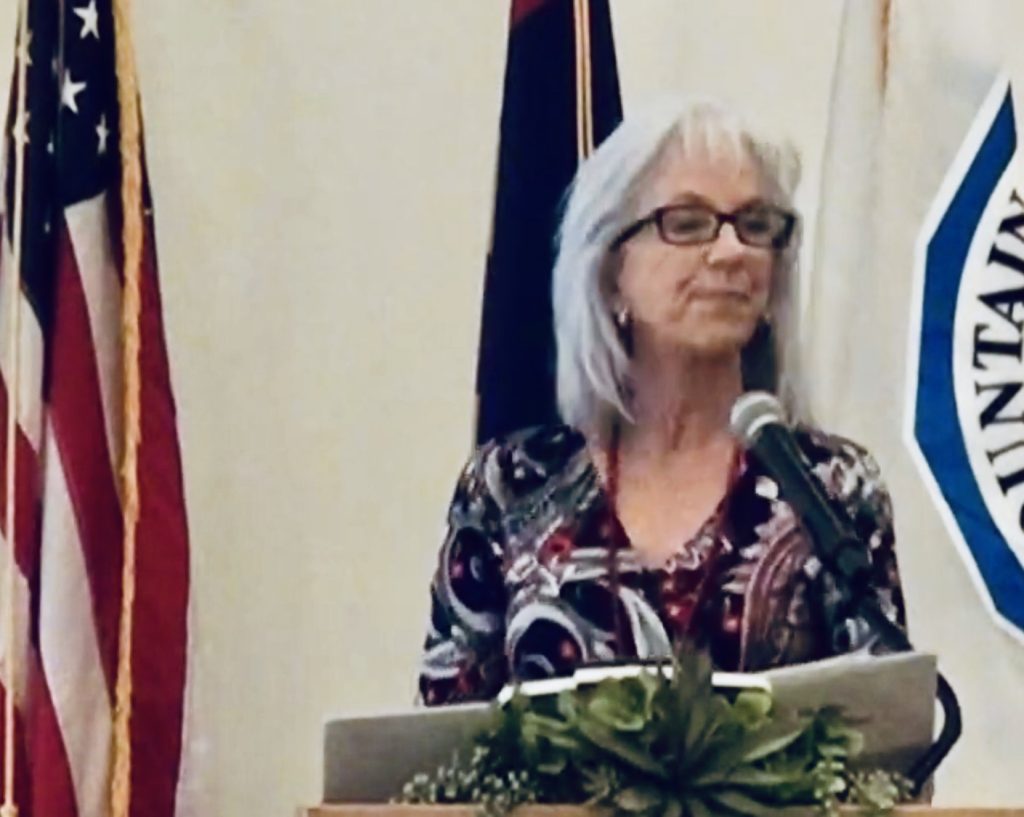
Our effervescent mayor, generally overflowing with positivity and goodwill, was clearly worried. Those who had been paying attention to the events of the preceding months knew that she had every reason to feel that way.
Like her mood, the title of Mayor Dickey’s January 2024 address, “At a Crossroads,” differed dramatically from the optimism of her presentations from prior years, for example, “Together”; “Engaged”; “Moving Forward”; “Rising Above and Vibrant.”
Optimism was difficult to muster following the election of “conservative” candidates controlled by ROT, intent on advancing a hyper-partisan agenda and their individual Christian nationalist beliefs. Hannah Toth and Allen Skillicorn, both elected in 2022, had joined forces with disgruntled councilmember and wannabee mayor, Gerry Friedel, with the goal of ending the era of nonpartisan local government and beginning the culture wars. Where there was a “left” and there was a “right” and there was nothing in the middle.
Skillicorn, whose Christian nationalist beliefs were readily apparent, fired the opening salvo when, within days of taking office, he falsely accused Mayor Dickey of “banning prayer” as he took credit in right-wing media outlets for bringing prayer back to Town Hall by restoring the pre-meeting invocation that had been suspended during the pandemic.
Skillicorn and Toth (now Larrabee) joined forces to stage repeated social media attacks on members of the LGBTQ+ community, that consistent with the tenets of their shared beliefs, they considered to be both aberrant and sinful.

Early on, the new councilmembers made a show of “undoing” actions of prior administrations they considered to be the product of a liberal left-wing bias. The Town’s Environmental Plan that they referred to as the “Green New Deal” was amended to delete “woke” language. The sign ordinance, the result of a years-long collaboration with local businesses, was repealed.
Fortunately for the town, Councilmember Kalivianakis, one of the candidates included on ROT’s Golden Ticket, determined that continuing the pursuit of ROT’s agenda was not advancing the town’s interests and demonstrated her independence by publicly supporting the proposed multi-use redevelopment of the Four Peaks Plaza. ROT and its supporters vehemently opposed the project and urged Town councilmembers to deny the requested zoning change that would allow for the construction of a four-story luxury apartment complex, whose residents would support the plaza’s restaurants and retail outlets.
The public opposition to the project focused on concerns over traffic and the introduction of high-density housing to a town known
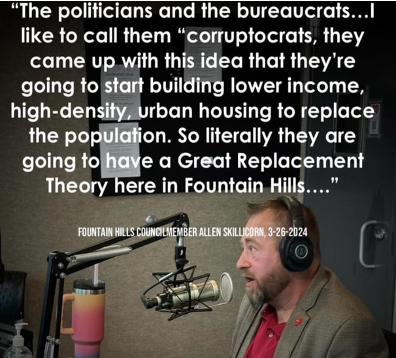
for its high-end, single-family homes and “small town” charm. But on social media and in group newsletters the focus was on the age, net worth, race, and political affiliation of the prospective tenants. Skillicorn promoted the bizarre conspiracy theory that the planned development was part of a conspiracy to “replace the population.”
Despite the opposition, the requested zoning change was approved. ROT pursued a referendum that failed because it used a wrongly coded form to collect signatures, resulting in litigation that was summarily dismissed.
In the months following her vote in favor of the Four Peaks Development, Councilmember Kalivianakis was deemed a traitor to those who had supported her, relentlessly harassed on social media, and falsely accused by Skillicorn and others of engaging in “ex parte” communications with the Developer’s representative and outright corruption.
Skillicorn was sanctioned for the accusations he made against the mayor and council members who supported the Four Peaks Plaza and for his assault of a town employee.
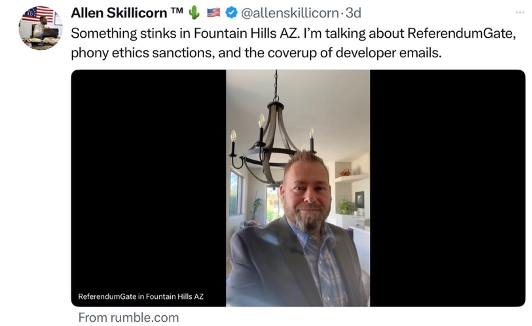
Skillicorn responded to the sanctions by filing his own frivolous lawsuit against the Town and the individual council members who voted in favor of the sanctions.
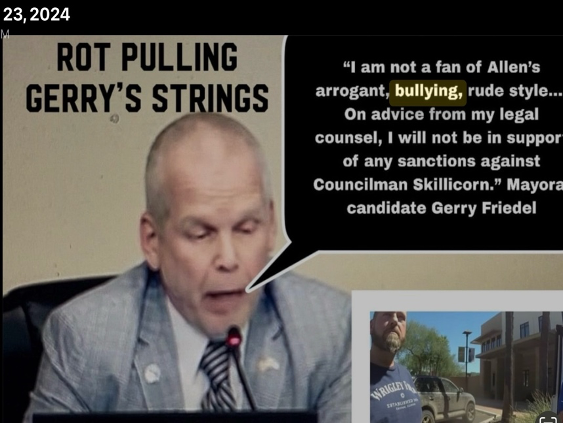
During this tumultuous period Friedel, intent on maintaining ROT’s support for his mayoral bid, largely stayed out of the fray. Although Friedel was critical of Skillicorn’s “bullying ways,” he voted against sanctioning him purportedly based on the advice of his attorney.
Friedel sided with ROT by voting against the zoning changes necessary for the Four Peaks Development to proceed. Friedel also supported Skillicorn’s resolution, directing the Town Attorney not to defend the Town or the individual defendants in the litigation brought against them by Crystal Cavanaugh and ROT. Fortunately, the resolution failed by a single vote and the Town and individual defendants prevailed in the litigation.
Throughout the chaotic months preceding her January 2024 address, Mayor Dickey continued to do her job with dignity and grace through contentious council meetings where she was personally attacked by members of ROT’s contingent and fractious arguments on the dais. Yet on that day two years ago, she restated her commitment to innovation, effective communication, supporting Town staff, and fostering volunteerism.
Mayor Dickey then stressed the significance of the upcoming election by again invoking the “crossroads” analogy, describing a path forward that would address our economic challenges and enhance our quality of life by relying on professional expertise and guidance, seeking public input, and engaging in reasoned public debate that would allow for balanced, mature decision-making.
She urged residents to reject the alternate path where the continued pursuit of a national, partisan agenda was likely to supersede or undermine the common goals for a local community including civility, unity, and lawful, predictable, fair governance.
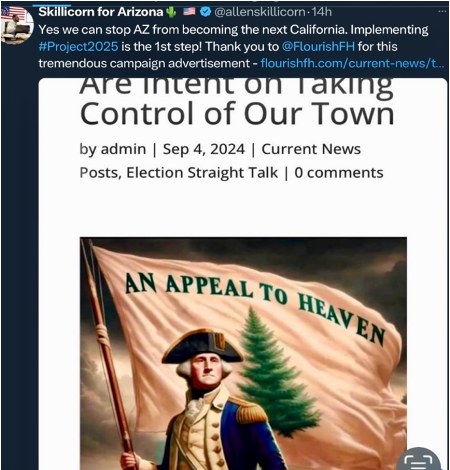
In 2024 the majority, misled and misdirected by ROT, Friedel, and outside influences including far-right organizations, voted to take us down the partisan Project 2025 path, a “victory” brazenly celebrated by Skillicorn as the “first step.”
As we continue taking steps down this road, our residents and our Town’s once stellar reputation have suffered. There have been scandals, cringeworthy council meetings, Attorney General investigations, and Notices of Claims that are likely to result in litigation that would cost taxpayers millions of dollars in legal fees and damages.
Under the ROT-controlled majority we have lost our right to file complaints against our elected officials for their ethical violations, have been evicted from our Town Council chambers, have been deprived of our right to speak during the Call to the Public, have been discriminated against, taunted, and maligned by our mayor and Town Council members, and have lost many valued employees and disenfranchised and discouraged many more. Our community cannot take another step down this dead-end road. This year, we have the opportunity to reverse course by rejecting the precepts of Project 2025 and its divisive culture wars by electing leaders who are focused on local issues, who value diversity, prioritize civility and unity; and who will listen and respond to all our voices.
It is time to turn around and begin walking back to the place we were before ROT took control of our town and our future.
The State of Our Town: Looking Back on a Chaotic Year
One year ago, Mayor Friedel opened his first State of The Town meeting with the following observation: “(i)t is important that we don’t deal in drama – we send the drama down to the theatre…the theatre deals in drama, we have town business to conduct.”
The irony of Friedel’s remarks will be painfully apparent to residents who have observed and been embarrassed by the very public, headline-generating dysfunctional drama of the past year. The drama was not “sent down” to the Fountain Hills theatre but has been center stage on the dais with Friedel, acting as the leading man in a parody of good governance and leadership.
Friedel has repeatedly demonstrated that he has no understanding of the role a Presiding Officer should play as he stumbles through the agenda, often relying on others to feed him his lines. He has failed miserably in his efforts to maintain decorum as he bullies, insults, and argues with other council members, relying on grimaces, scowls, growls, and his ever-present gavel in his portrayal of a small-town mayor on the verge of a nervous breakdown.
During the past year, the drama has overshadowed the conduct of the Town’s business and Friedel has only himself and his supporters to blame.
It was Gayle Earle who welcomed Jacob Chansley, the Q’Anon shaman, to celebrate the election of the new majority.
It was the new majority that responded to a valid ethics complaint filed against Friedel by dismissing the pending complaint and stripping residents of their right to file any future ethics complaints against their elected officials.
It was the new majority, through Gayle Earle, that orchestrated the resignation of our experienced and well-respected Town attorney by falsely accusing him of engaging in fraudulent billing practices to make way for ROT’s favored law firm, Timothy La Sota, PLC, a firm that pursued two meritless lawsuits against the Town.
It was the new majority that removed the sanctions imposed on Allen Skillicorn for assaulting a Code Enforcement officer.
It was Friedel and two members of the new majority who violated the Establishment Clause, resulting in a Notice of Claim against the Town.
It was Friedel and two members of the new majority who were responsible for the removal of the media table from the council chambers to symbolically punish the Fountain Hills Times Independent for what they viewed as biased reporting.
It was Friedel who demanded that a person of color identify herself as a current resident before she would be allowed to speak.
It was Friedel, who in a fit of pique, illegally ordered MCSO deputies to evict the public from council chambers and then barred them from reentering, resulting in an Open Meeting Law complaint filed with the Attorney General.
It was a member of the new majority who brazenly boasted that in voting to end the Call to the Public, she was punishing residents who had spoken truthfully about her mentor, Charlie Kirk, by “taking away your toy.”
During the past year, much of the business conducted has had nothing to do with the “good of the town” and everything to do with partisan signaling – declarations of hollow victories in the pointless “culture wars,” like:
- Banning Tik Tok;
- Banning diversity, equity and inclusion;
- Making English the Town’s “official language”;
- Resolving not to interfere with or obstruct ICE;
- Resolving that Fountain Hills would never be designated a sanctuary city;Removing the sanctions imposed on Allen Skillicorn for assaulting a Town Code Enforcement Officer; and
- Rejecting a $250,000 federal grant because it used “woke” terms.
During the past year the new majority has made no meaningful progress on fulfilling the pledges Friedel made in his first State of the Town address:
- Construction on Park Place Phases II and III did not begin last April, but has been abandoned by the developer as evidenced by the Notice of Claim he filed seeking $9 million for the Town’s breach of contract and Jennifer Wright’s alleged malfeasance.
- The MCSO contract has not been renegotiated.
- The Town has not “put away” 75-90 percent of the projected cost of replacing the lake liner.
- There is no plan to address the revenue shortfall that increases the backlog of streets in desperate need of repair every year.
Friedel continues to show up for photo ops at ribbon-cutting ceremonies and public events. He also continues to produce his self-congratulatory “Friedel Friday” videos where he preens in front of popular projects initiated and approved when Ginny Dickey was mayor. Projects that during his campaign he denigrated as wasteful “nice to haves.”
Friedel has busied himself by inventing a “Mayor’s Special Service Award” whose recipient, a contributor to his campaign, was recognized for visits she made to North Carolina to assist in hurricane relief. Friedel also took it upon himself, based on criteria known only to him, to identify local businesses deserving of being put under his “Mayor’s Business Spotlight” and choosing the “Veteran of the Month” from the more than 2,800 men and women eligible for recognition.
Friedel took it upon himself to overrule staff by demanding that the Republican Club be allowed to violate a policy designed and intended to prevent divisive partisan politics from marring the Community Center’s holiday display. He also took it upon himself, following residents’ complaints, to decide the order in which streets will be repaired.
Meanwhile, the Community Center is in dire need of repair and restoration; ordinances controlling cell tower regulation are in limbo; the blight of vacant commercial buildings remains unaddressed; revenue for restaurants and entertainment, projected to increase, remain flat; and the conundrum of what to with Plat 208 continues.
The ineptitude and blatant missteps of the first year of the Friedel administration have not gone unnoticed. They have gone viral on social media, generated reputation-destroying headline, and resulted in Attorney General investigations and threatened litigation.
A year ago, during the State of the Town meeting, Friedel invited residents to measure his success as a “great leader” by his ability to build a cohesive team working together for the good of the residents. Based on that standard, Friedel has proven himself to be anything but a “great leader.”
We Can Raise a Million Dollars to Support Our Schools and It Won’t Cost Us a Dime
Many of us recently received this mailer from the Fountain Hills School District, urging us to support excellence in our schools by taking advantage of the Arizona state tax credit for public schools.
Almost two decades have passed since the state legislature enacted a statute – A.R.S. §43-1099 – intended to encourage private donations to public schools by giving taxpayers a dollar-for-dollar credit for amounts owed as state income tax for contributions made to public schools. The amount of the credit that can be claimed is subject to a cap, which is currently $200 for those filing an individual return and $400 for those filing joint returns.
Sadly, for our underfunded school district, residents of Fountain Hills have not taken full advantage of this opportunity to redirect their tax dollars to two of our town’s most valuable assets: our schools and our children. If the 2,980 voters who supported the general obligation school bond in 2023 took advantage of the tax credit, we could add up to $1 million dollars to the FHUSD’s budget for extracurricular activities. This figure could easily double if all residents who value our public schools participated in the tax credit program.

The donations cannot be used to fund capital improvement projects, but provide direct benefit to our students by funding: enrichment activities like field trips, music, and clubs; school sports; prep courses, materials, and fees for standardized tests; career and technical education certifications; and tutoring. Devoting more funds to these extracurricular activities will further enhance the reputation of our schools, diversify and improve the educational experience for our students, and attract new students. The FHUSD has made it easy for residents to participate in this program. You can make your donation online by completing the Tax Credit Contribution Form found on the District’s website: www.fhschools.org.
In the alternative, you can deliver or mail checks payable to FHUSD to the superintendent’s office: 16000 E. Palisades Blvd., Fountain Hills, AZ, 85268.
Getting your tax credit is equally easy to do. When filing your Arizona state income tax return, you only need to:
• Use Arizona Form 322 (Credit for Contributions to Public Schools);
• Enter the amount of your donation (up to the applicable limit); and
• Attach Form 322 to your return.
The clock is running. To qualify for the credit on your 2025 tax return, donations must be made to the FHUSD prior to April 15, 2026.
We can do this Fountain Hills! If we can raise the funds and find volunteers to rebuild a football field, we can raise a million to enhance our children’s education by making a donation and filling out a few forms. Spread the word by sharing this post. We will be reporting on our progress.
Another Example of the Mayor’s Partisanship
By Janna Dutton.
Once again, Mayor Friedel has demonstrated clear partisanship in town governance. He has repeatedly supported politically motivated resolutions—such as declaring English the official language and banning nonexistent DEI initiatives—that serve no legitimate local purpose while fostering needless division in our community.
Most recently, he overrode Community Center staff and policy by granting the Republican Party an exception to the ban on partisan political displays at the holiday tree exhibit. This allowed them to feature a picture of Donald Trump atop their tree—an inappropriate political statement during a community celebration meant to unite, not divide, our residents.
Town leadership should bring people together, not use public spaces to advance partisan agendas.
Misrule by Design: How a Council Majority Undermined Fountain Hills
By Don Scott.
As 2026 begins, it is important to reflect on the direction taken by the Fountain # Fountain Hills Hills Town Council in the past year—and to be clear about who bears responsibility for a period marked by unnecessary division, reputational harm, and misplaced priorities.
The Council majority—Friedel, Skillicorn, Larrabee, Earle, and Watts—advanced a series of actions aligned with the political action committee Reclaim Our Town (ROT) that did little to address the town’s real needs while eroding civic trust and damaging the town’s in-state reputation.
Among the most consequential decisions were the ban on DEI initiatives—despite the town having no formal DEI programs or policies in place—the symbolic declaration of English as the town’s official language, and restrictions on public comment that curtailed residents’ ability to speak freely at their own council meetings. These actions addressed no pressing problem while reiterating an unmistakable message of exclusion rather than community.
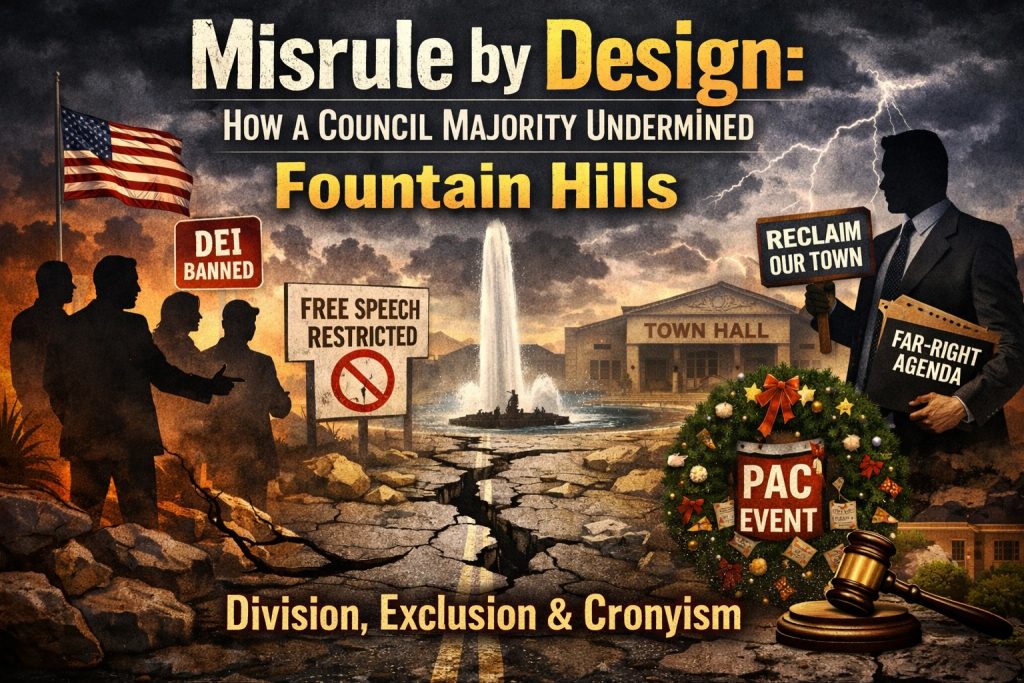
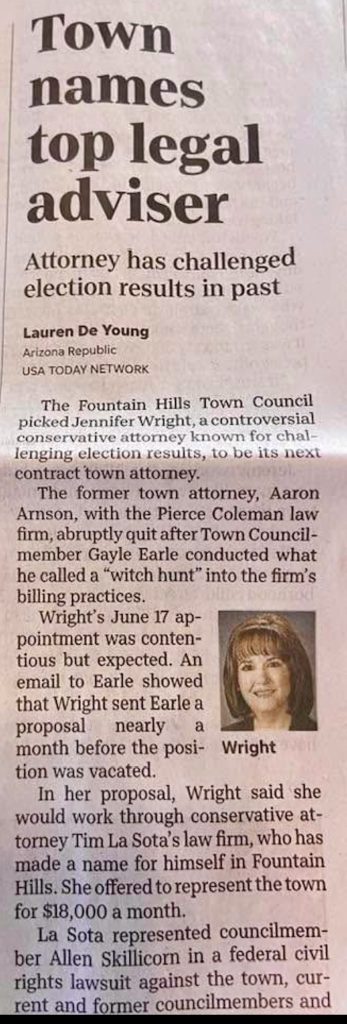
Equally troubling was the appointment of a Town Attorney aligned with election denial and far-right ideology, raising legitimate concerns about independence, judgment, and the long-term credibility of town governance.
Before the year ended, Mayor Friedel compounded this pattern by overriding Community Center staff and explicitly created neutrality rules to grant preferential treatment to his PAC allies—authorizing a political display as part of the facility’s traditionally nonpartisan holiday celebration. What should have been a unifying, festive event instead became another example of favoritism over professionalism.
Fountain Hills is not defined solely by these choices. Many residents continue to advocate for inclusive, community-first leadership that values diversity, professionalism, and civic trust—principles reflected by organizations such as Flourish Fountain Hills.
As the new year begins and election season approaches, residents deserve leadership focused on solutions, respect for democratic norms, and the well-being of the entire community.
Whimsical Woodland: Autocrat Mayor Undermines Staff
In Show of Self-Serving Favoritism, Friedel Rejects Rules to Make His Own.
 First, let’s recognize a mostly gorgeous exhibition of seasonal spirit and festive celebration with the Community Center holiday tree and wreath display! The theme this year was Whimsical Woodland Holiday:
 Step into a storybook forest filled with natural charm and holiday magic. Imagine a woodland scene where charming foxes, owls, and deer nestle among mossy branches, toadstools, pinecones, and twinkling lights. Rustic textures like burlap and frosted berries add a cozy touch to this enchanting celebration of nature and seasonal wonder.

 CONGRATULATIONS to Fearless Kitty Rescue (Best Whimsical Woodland Theme) and Trinity Lutheran Church (Classic Holiday)! Their beautiful trees are pictured below.


 Unfortunately, one group and one mayor believed that the rules didn’t apply to them.
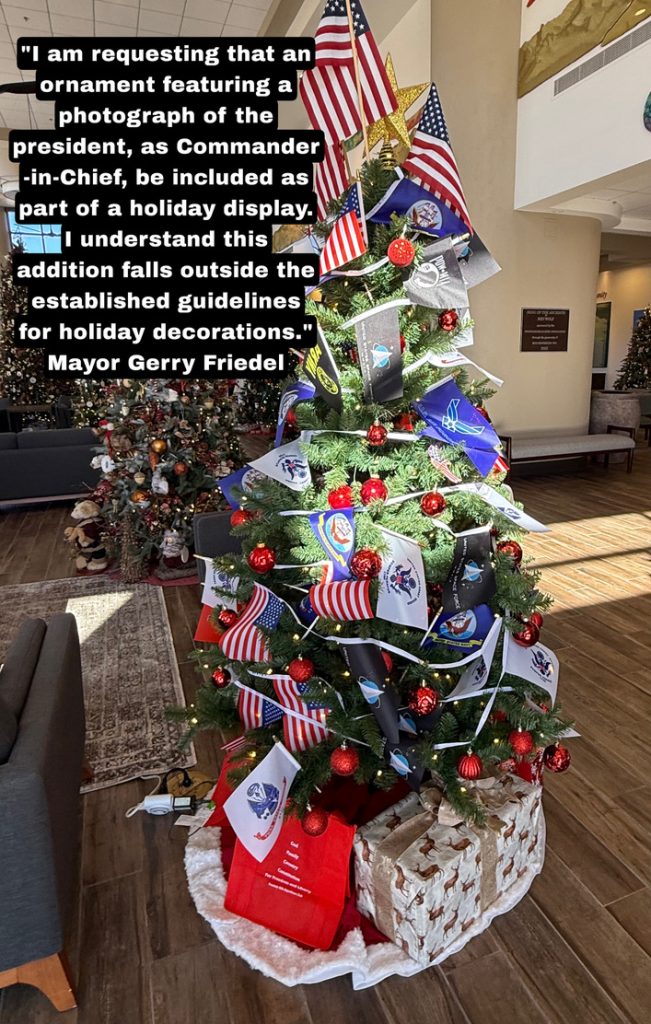
When Fountain Hills Community Center staff rejected a local Republican Party tree featuring a Trump image intended to top the display, Mayor Gerry Friedel intervened and sided with a complaint from fellow Republican Club member and chairperson for the political action committee that endorsed him, ROT. In an email to Community Center staff (included in full below), Friedel wrote,
“I am requesting that an ornament featuring a photograph of the President, as Commander-in-Chief, be included as part of a community display. I understand this addition falls outside the established guidelines for holiday decorations….”
In that same email, Friedel acknowledged the implications of his intervention, stating, “Please know that this request is being made at my direction. I appreciate that it may cause some concern among staff or members of the community, and I want to be clear that any questions or concerns about this decision should be directed to me—not to staff.”
By his own admission, Mayor Friedel overrode staff who were explicitly charged with enforcing the rules and exercising final decision-making authority agreed to by all participants. His unilateral action—interceding to overrule the governing process—allowed the political tree and Trump decoration (a clear departure from the Whimsical Woodland theme) to proceed, despite staff’s conscientious efforts to ensure the Community Center holiday display “remains a welcoming and enjoyable celebration for everyone who participates,” in accordance with rules designed to “keep the focus on participation, inclusion, and celebration.”
This year’s theme for the event was Whimsical Woodland Holiday. All other participants followed the established guidelines and contributed to a nonpolitical, inclusive, and festive display. The Republican Party’s violation—enabled by the mayor—disregarded staff authority, disrespected residents, and injected partisan politics into what was intended to be a community celebration.
Prior to Mayor Friedel’s intervention, ROT chairperson Crystal Cavanaugh wrote to Town Manager Rachael Goodwin, urging her and Community Center staff to “reconsider and approve the Trump ‘tree topper’ photo image,” asserting that “it does not seem to break any rules” and is “in no way offensive.”
In contrast, a participating member of the Fountain Hills Democratic Club affirmed the guidelines and staff’s authority. Fountain Hills Democratic Club member Al Ronca, upon learning of this tree inclusion, wrote to the town manager as well:
“I thought that as a member of the Democratic Club board that when we signed the submission form, we agreed to all the guidelines. A move that our board wholeheartedly endorses and supports. I am a Vietnam vet and I support our military 100%. But it’s a stretch to say that a tree honoring the branches of armed forces has anything to do with woodland creatures.”
Resident Ken Meyers also contacted Ms. Goodwin, questioning the rejection of the Trump image: “I have heard that you, as Town Manager, decided that the photo of Commander-in-chief Trump would not be allowed.”
In a respectful and thorough response, Town Manager Goodwin clarified staff authority and the intent of the guidelines, writing in part:
“Following several challenges and misunderstandings that arose last year, new guidelines were thoughtfully developed in collaboration with staff, the Town Manager, and the Town Attorney to help ensure the focus remains on celebration, community, and the holiday spirit. The guidelines note that no political displays are permitted, and that STAFF HAVE THE FINAL SAY ON ANY MATERIALS THAT MAY BE CONSIDERED QUESTIONABLE TO ENSURE THE NEUTRALITY OF THE COMMUNITY CENTER. All participating groups reviewed and signed a consent form agreeing to these terms before decorating.”
Ms. Goodwin further emphasized: “I also want to be clear that I am not the unilateral decision-maker in these matters. The intent of this process — and of the guidelines themselves — is to remove personal discretion and politics from staff’s hands as much as possible…. The determination was made in keeping with the agreed-upon guidelines, which prohibit displays that could reasonably be perceived as political in nature. Our goal continues to be preserving the neutrality of the Community Center and ensuring this long-standing program reflects the welcoming and festive spirit of the season.”

When Community Center staff evaluated the appropriateness of decorations for the Whimsical Woodland Holiday theme, the group charged with decision-making applied the following rules, terms, and conditions in accordance with the established guidelines:
 Fountain Hills Community Center
Each year, the Fountain Hills Community Center invites members of the community to help decorate the Community Center to celebrate the holiday season. The Holiday Decorations are a reflection of the Town of Fountain Hills and are intended to create a welcoming and festive environment at the Fountain Hills Community Center.
Holiday Decoration Terms & Conditions
To support a festive, respectful, and welcoming environment for all residents and visitors, the Fountain Hills Community Center has set forth the following Terms and Conditions to govern the Town of Fountain Hills’ display of the Holiday Decorations in and around the Fountain Hills Community Center. The Fountain Hills Community Center will only display Holiday Decorations from individuals, groups, or organizations adhering to the following rules:
To maintain a respectful and family-friendly atmosphere:
• Decorations must reflect seasonal or holiday themes that are suitable for all ages.
• Displays must be welcoming to the entire community.
• Displays must be joyful and festive.
Prohibited Content Includes (but is not limited to):
• Political content, including political slogans, campaign signs, or any expression supporting or opposing political candidates or ballot issues.
• Offensive or inappropriate material, including anything obscene, violent, profane, indecent, or otherwise inflammatory.
Disruptive or disparaging elements that could create community conflict or detract from the intended spirit of celebration.
Conduct
All individuals and groups are expected to:
• Treat others with courtesy and cooperation.
• Follow all staff instructions and posted guidelines.
• Avoid disruptive, disrespectful, or harassing behavior. Violations may result in removal of decorations and/or exclusion from future events.
Rights Reserved
The Fountain Hills Community Center reserves the right to:
• Deny, remove, or request modifications to any display that violates these terms or is deemed, at staff discretion, inappropriate, unsafe, or inconsistent with the values of a welcoming public space.
Agreement & Acknowledgment
By signing below, the participant acknowledges that they have read, understood, and agreed to comply with these Holiday Decoration Terms and Conditions.
This behavior has escalated over time. It is long past time for it to end.
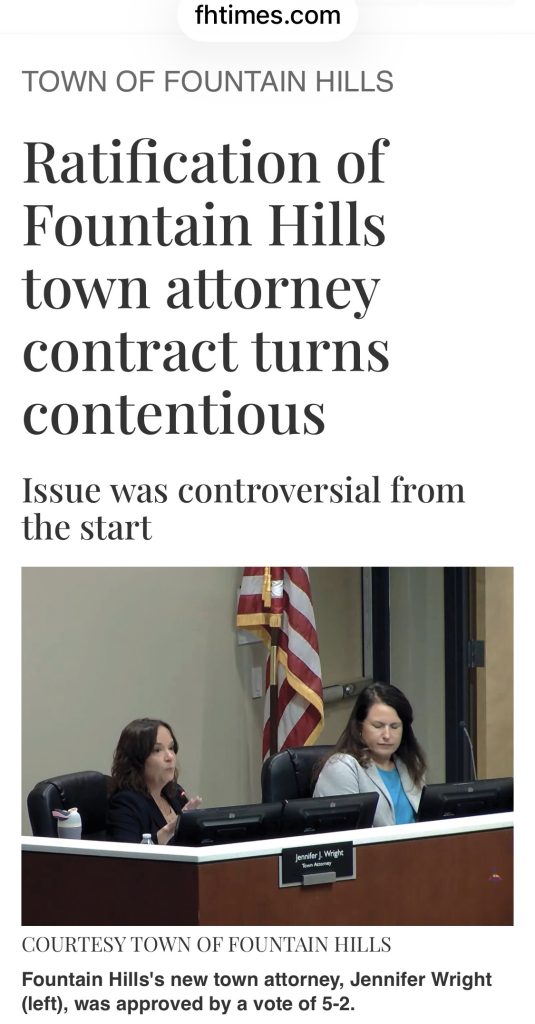
Jennifer Wright Officially Joins Team ‘Hide the Ball’
Gerry Friedel and his four teammates have accomplished little during the first year of the ROT administration. Our streets are still in bad shape, and no plan has even been suggested as to how, given our current revenue, we could possibly pay to fix them. There has been no promised “renegotiation” of the MCSO contract. The funds available to replace the lake liner remain grossly inadequate. Based on Bart Shea’s recent defiant pronouncement, we can look forward to years of litigation as we stroll past the giant unfenced field of dust and mud he promised to leave on our town’s premiere street.
And then there has been the proliferation of reputation-killing headlines that have been generated as the ROT administration’s failed efforts to hide the ball have been uncovered.
In March, Friedel’s claim that his meetings with Sheriff Sheridan resulted in a $370,000 reduction in the cost of police services was revealed as a lie. A month later, team member Gayle Earle was caught hiding the ball when, after accusing the former town attorney of fraudulent billing, it was revealed that before her “audit” was even completed she had been in communication with ROT’s favored firm, Timothy La Sota, PLC and Jennifer Wright, to take over the job. Then, Friedel’s claim that the press table was removed from the council chambers due to space concerns was exposed as a lie when communications from team members Watts and Larrabee were produced, proving that removing the press table was intended to punish Bob Burns, a 37-year journalist of the Fountain Hills Times/Times Independent, for his reporting.
And now Jennifer Wright, in her role as the designated hitter, assigned to clean up Friedel’s mess in the aftermath of the disastrous
September 15 meeting, has demonstrated that she, too, prepared to play hide the ball. According to Wright’s “legal opinion,” it was necessary to eliminate the Council Reports and Call to the Public agenda items to protect the town from additional claims based on violations of the Arizona and U.S. Constitutions.
As stated by Wright during the November 18 meeting:
“And so umm that’s why that this is these changes to the rules of procedure are an attempt to balance the First Amendment rights of the community against the threats of lawsuits. Importantly the Culp complaint seeks to demand the Town engage in constitutionally, prohibited viewpoint, content discrimination by prohibiting speakers from including any statements of faith and taking that approach would invite a civil rights complaint and subject the town to potential financial liability. So umm that uh removing these this these two these two items at least temporarily are reasonably calculated to um and avoid any potential civil rights complaints if you were to engage in the conduct suggested and uh to prevent more abusive complaints um on these topics.”
Wright’s poorly articulated rationale is absurd. The risk of future claims arising out of the violation of residents’ constitutional rights is not eliminated by getting rid of two agenda items where those violations could possibly occur. There is a risk that constitutional rights may be violated any time someone speaks at a public meeting. Councilmembers Skillicorn and Larrabee don’t need a “Council Reports” agenda item to engage in proselytization or to quote scripture. Eliminating the Call to the Public will not prevent Town Council candidate Ben Larrabee, or another religious extremist, from launching into a religious tirade. Larrabee could deliver the same speech while at the lectern during a public hearing or when speaking to an agenda item.
The risk of future constitutional claims can never be eliminated by limiting the opportunity to speak at a public meeting. Council members must be able to speak in order to address the secular business of the town and members of the public have a statutory right to speak to certain agenda items. The only meaningful way to control claims is to enforce the Rules of Procedure.
If Friedel and Wright had done their jobs and enforced the Rules during the September 15 meeting, there would have been no claim for violation of the Establishment Clause. Consistent with the Rules, Pastor Pavia’s presentation should have been limited to delivering the invocation, without the eulogy. Councilmembers Skillicorn and Larrabee should have been told to limit their presentations to a discussion of their town-related activities during the prior two weeks. Ben Larrabee should have been instructed to limit his comments to a topic within the Town Council’s jurisdiction.
Contrary to Ms. Wright’s rambling opinion, in a limited public forum—like a Town Council meeting—it is constitutionally permissible for the government to use its Rules of Procedure to restrict or limit speech based on the subject matter, the speaker’s designated role in the proceedings, and by the relevance of the speech to the secular business of the town. The risk of claims for violation of the First Amendment rights of speakers at a public meeting arises only when the Rules of Procedure are not neutrally and consistently applied. In the case of the September meeting, due to Wright’s silence and Friedel’s ineptitude, the Rules were entirely ignored.
Wright’s strategy to hide the ball from the public, through a fatally flawed “opinion,” will be exposed because it is not based on a legitimate legal analysis. But in addition, and perhaps more importantly, it will be exposed because it does not pass the smell test, revealing Wright’s willingness to subvert her ethical obligations to the Town to the political goals of its mayor.
Providing residents with a public forum to challenge Friedel and question his effectiveness was not consistent with his goal. Providing Councilmember Kalivianakis with a public forum to discuss her activities on behalf of the Town and its residents was not consistent with that goal. And so, the dutiful Wright constructed a specious legal framework to justify getting rid of both public forums.
Under the ROT administration, if the law threatens your leader’s chance of being reelected you need to get rid of the law. That is an approach you can take when you have four teammates and a Town attorney who are ready, willing, and able to subvert the public interest to further his ambitions.
Do You Remember Mayoral Candidate Friedel Running on ‘Transparency’? We Do!
“In a chaotic discussion wherein Mayor Gerry Friedel had Sheriff’s deputies clear the council chamber of the audience, Fountain Hills Town Council voted 5-2 to remove open public comment and personal councilmember updates from future agendas.”
Do you remember Councilmember Gerry Friedel running on and vowing TRANSPARENCY while campaigning for mayor? We do!
Under Friedel and the ROT-majority council, the ability for residents to file ethics complaints under the town’s Rules of Procedure was eliminated earlier this year — ironically, just a short time after a resident’s ethics complaint was filed against Mayor Friedel for making misleading and false statements in an effort to take undeserved credit for a 6 percent reduction in the amount Fountain Hills residents will pay for MCSO police services in FY 2026. And now, open public comment for residents has been voted out by this majority, and its attorney, Jennifer Wright.
“I’m concerned that the effort to limit public participation will leave the only recourse to be heard is complaints to the attorney general and lawsuits,” Councilmember Peggy McMahon said. “This is a setup for additional actions.”
“Last night’s town council meeting ended the time-honored tradition of the people’s right to address their councilmembers in person and in council chambers,” stated Councilmember Brenda Kalivianakis. “The council has a fiduciary duty to listen to the citizens and make policy based on their input. After tonight’s vote, there is a distinct sense that the people of Fountain Hills are not being served, but rather, ruled over. Listening to the people is imperative to representative government.”
You cannot have transparency when actions are taken to censor and silence residents!
(Quotes courtesy of the Fountain Hills Times Independent.)
Setting the Record Straight on What Happened at Town Hall
By Eric Landau.
We know that (Fountain Hills Times Independent) frowns on back and forth letters between readers, but this one was really necessary.
The letter from Wendy Corry about “rewriting history” is grossly inaccurate, and can’t be allowed to stand unchallenged. I too was there at the 11/18 Town Council meeting. I spoke regarding three agenda items both before and after the mayor ejected the attendees. The audience had reacted spontaneously to his unjustified attempts to stifle its reactions to numerous outrageous pronouncements from the dais. This was not planned; these were simply inevitable responses to shocking behavior which he perpetrated and countenanced, including Ms. Larrabee’s gleeful announcement that she was “taking away your toy,” a reference to Call to the Public.
I’m sorry that citizens reacting to the stifling of free speech somehow allegedly threatened Ms. Corry and made her fearful, but this was democracy manifest, not some sort of near riot as she described. There was no “intimidation” nor anything “scary” on the part of the mainly 70-ish attendees. The only fear in that room was probably on the part of the mayor when he saw that his browbeating didn’t work. His low flash point has no tolerance for anything but instant obedience, but we would not be cowed.
Mr. Friedel’s displeasure that the audience did not submit to his dictatorial expectations caused him to repeatedly glare and threaten us, his constituents, eventually ordering the room cleared when he saw that he could not command unearned respect. The sheriff’s captain and sergeant were peaceable not only in executing his orders to have everyone leave but also in then successfully negotiating, in the highest tradition of diplomacy, for the meeting to reconvene and continue. The only one seeking to rewrite the history of what occurred is Ms. Corry.
Town Council’s Actions Have Pushed Fountain Hills Into a “Dark Chasm”
By Bryn Henning.
As a resident of Fountain Hills for over two decades, under many mayors and elected officials, I am appalled by the latest town council and mayor’s decision of silencing the public.
I don’t march nor get involved in protests. I don’t go to social media. I do watch our local news, read different newspapers and watch YouTube videos of our town council meetings. These last few weeks, my small and beautiful town that I love has gone into a dark chasm of ugliness.
I am retired and I have a lot of time to research to find the answers to my own questions: “What happened? Why and how did we get here?” Quietly and studiously, I looked for answers.
What I found: In 2022 Town Council Member Allen Skillicorn was elected. During his tenure he had ethics violations, for which he was sanctioned. He also sued our town, our mayor Ginny Dickey, for sanctioning him. He lost.
Fast forward to the Nov. 18, 2025, town meeting, it was clear to me that mayor Freidel and some town council members treated Allen as if he was the true leader and mayor, influencing the rest. Then, the live feed was cut. Further, Mrs. Larrabee said it was time to take away the “toy,” referring to public comments. Her words rattled me.
Larrabee and Skillicorn, how dare you use the dais to silence anyone who dissents? You have both awakened a quiet senior to pay attention to your disruption. Earle, Watts and mayor Friedel, shame on all of you, too, for following them.
Nowhere in our constitution had the word “toy.”
A Troubling Attempt to Silence Fountain Hills Residents
By Faryl Palles.
Tuesday, Nov. 18’s Town Council agenda contains a proposal that should alarm every Fountain Hills resident. They are considering pausing both councilmember reports and the call to the public for six months.
The justification offered, that this relates to a pending Notice of Claim, doesn’t hold up. Rather, it appears to be a strategy to insulate Mayor Gerry Friedel and his allies from public oversight at a moment when their conduct is under substantial scrutiny.
I’m getting that “déja vu all over again” feeling here. After an ethics complaint was filed against Mayor Friedel for making false statements about his meeting with Sheriff Sheridan, the council majority dismantled the portion of the ethics code that allowed residents to file ethics complaints. Problem solved!
Now, as another claim moves forward, the public’s speaking rights are suddenly on the chopping block. As the saying goes, when every problem looks like a nail, a hammer is the only tool you need.
And this comes on the heels of the Sept. 16 meeting, when Mayor Friedel allowed religious sermonizing, political commentary and the eulogizing of Charlie Kirk in the midst of town business.
Now, this move could silence residents altogether. No filing those pesky ethics complaints, no more cantankerous residents speaking during call to the public. Presumably, residents will still be allowed to speak about agenda items as they come up. Nothing in the rules suggests that taking public comment on an agenda item is optional or discretionary, but who knows how far this council will go to clamp down when criticized?
Our community deserves leaders who can run a lawful, orderly meeting, not officials who respond to accountability by shutting out the public. Fountain Hills residents should reject this attempt to limit their voices.
Sprouts Is Coming – But Don’t Forget Who Tried to Stop It
By Don Scott.
My sadness over Petco’s departure from Fountain Hills was soon replaced by excitement that Sprouts Farmers Market is moving in. Known for fresh, organic food, wellness products, and extensive plant-based options, Sprouts saw a 22% jump in plant-based sales—no surprise given its delicious variety.
In the company’s Impact Report, its CEO stated: “We’re sourcing more innovative products that are healthy, attribute based, and have a lower environmental impact and higher societal benefit. We’re reducing waste and donating more meals to those in need than any year in our company’s history. And we’re making meaningful strides in fostering our culture of caring and inclusion while also investing heavily in team members’ development and well-being.”
Sprouts likely wouldn’t be coming had the rezoning application—enabling Sandor’s development of upscale, market-rate apartments at Four Peaks Plaza—not been approved in 2024 in a 4-3 vote by Mayor Dickey, Vice Mayor Grzybowski, and Councilmembers McMahon and Kalivianakis. Without that approval, it’s also feasible that Target would have departed.
Mayor Friedel touted the Sprouts intent in his June 6 video. Yet he, along with Councilmembers Skillicorn and Larrabee, voted against the very rezoning that made it possible. Their political action committee, ROT, tried to thwart the project. ROT filed suit to stop it, and it was Skillicorn who then pushed a resolution instructing Town Attorney Aaron Arnson to step aside in defense of the Town. Friedel and Larrabee supported the move—effectively abandoning the Town’s legal defense—but were, fortunately, again outvoted.
So, when Friedel in his video enthusiastically listed potential benefits like “permitting fees,” “construction sales tax,” “development impact fees,” and “retail sales tax,” I shook my head at the hypocrisy.
“This is huge for Fountain Hills,” Friedel said.
But he hopes you’ve forgotten who tried to stop it.
Town Council: We Have Seen What Extreme Partisanship Looks Like. Is This What We Want?
For more than a century, local elections in Arizona have been nonpartisan. Arizona law (A.R.S. § 9‑821.01) requires that municipal ballots for mayors and councilmembers show no political party affiliation.
The long-standing practice and the statute are based on the belief that local governments should focus on matters essential to the operation and management of community resources for the collective benefit of all residents. Nonpartisan elections encourage and empower voters to elect candidates based on their experience, community involvement, character, and their positions on matters of local concern. Nonpartisan elections insulate elected officials from partisan influences, freeing them to adopt policies and make informed decisions that benefit the entire community. Nonpartisan elections attract a more diverse range of candidates to run for office, and promote a culture of collaboration and civility on councils, boards, and commissions.
There have been efforts to bring an end to nonpartisan elections. In 2023, the Arizona Legislature passed SB 1011 that would have allowed partisan local elections in the state. The bill was vetoed by Governor Hobbs. So, for now, at least, our local elections remain officially nonpartisan. But recently in Fountain Hills, it certainly doesn’t feel that way.
Since 2022, when political action committee best known as ROT descended on Fountain Hills — intent on taking control of town government by conducting a dirty, deceitful campaign against candidates they labelled as “communists,” “radicals,” and “leftists” — our elections have been “nonpartisan” in name only.
In 2024, following another ugly campaign, ROT succeeded in gaining majority control over our Town Council. Since the election, the ROT majority — Gerry Friedel, Hannah Larrabee, Allen Skillicorn, Gayle Earle, and Rick Watts — have had control. Within weeks of the election, any hope that we may have had that our newly elected leaders would independently exercise their judgment and take actions designed to serve the best interest of the community were dashed.
Since January, the ROT majority has systematically embarked on a collective hyper-partisan effort to deprive residents of their right to hold them publicly accountable and transform Fountain Hills into a MAGA Republican enclave: where Fountain Hills Community Center staff can be bullied by the mayor to allow the Republican Club to adorn its holiday tree with a Trump ornament, despite the Center’s “no politics policy”; where consideration is being given to allowing private donors to erect a Charlie Kirk memorial on town property; and where our Town Council continues to make headlines by enacting meaningless resolutions intended only to illustrate the majority’s allegiance to Donald Trump’s divisive MAGA policies.
Under this Maga Republican administration, our Town Council meetings have devolved into bimonthly chaotic exercises in incivility where the gavel is repeatedly banged, the Rules of Procedure are ignored, insults and accusations are routinely exchanged, and executive sessions outnumber regular meetings.
The questions we, as voters, must address is whether there is any path that will take us back to a time where our elected officials sought collaboration — not capitulation.
One of the obstacles on the path away from partisanship is the expense now associated with campaigns for local office. Although the statute requires that elections be nonpartisan, partisan organizations, on the local, state, and national level are not prohibited from funding the campaigns of local candidates.
The 2022 Fountain Hills mayoral campaign stands as a stark example of how the involvement of a known partisan candidate impacts spending. In 2022, Joe Arpaio — supported by a national fundraising organization — solicited contributions from thousands of out of state donors and reportedly spent more than $160,000 in his unsuccessful bid for mayor. That same year, Ginny Dickey spent close to $40,000, close to double the amount spent on her last contested election in 2018. In 2024, with three candidates in the mayoral race, the combined cost of the campaigns exceeded $250,000: a quarter of a million dollars spent vying for the privilege of serving a two-year term as the mayor of this small town.
As the 2026 election looms, the three members of the Republican slate have been identified and it is anticipated that, as it has in the past, ROT will support them through attacks on their opponents. These candidates will also receive financial support from the local MAGA base. However, there are now other players, outside our boundaries, who are expected to inject themselves and their resources into the mix.
During the 2024 campaign the NicoPAC, known for providing support for far-right candidates, paid for signs promoting Gayle Earle, Rick Watts, and Matthew Corrigan. The NicoPac also paid for the giant black “Dishonest Dickey” signs that scarred our streets and parking lots for the weeks before the election. There is also a concern that Turning Point Action, the political arm of the late Charlie Kirk’s organization, Turning Point USA, will through its affiliated PAC direct its considerable resources to support Ben Larrabee’s candidacy. Ben Larrabee, and his wife, current councilmember Hannah Larrabee, are both employed by Turning Point Action.
Which leads to the following inevitable and disturbing questions: Why are these outside organizations meddling in our election? What do they have to gain? And, more importantly, what do we have to lose? More to come.
A Town Attorney Appointment Undermining Public Trust
It has been three months since the Fountain Hills Town Council belatedly approved the Professional Services Agreement appointing Timothy La Sota, PLC, a firm that twice sued the Town, to serve as Town Attorney.
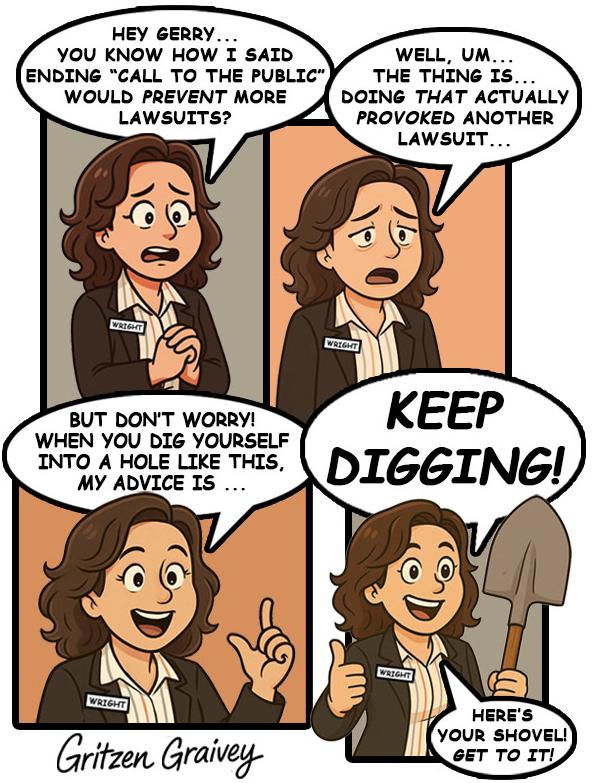
Although Jennifer Wright’s name does not appear in the Professional Services Agreement, she has been designated to act as our “primary designated attorney.” In the Professional Services Agreement, the La Sota firm undertook to provide “adequate, experienced personnel” to serve as the designated attorney. Wright had no meaningful prior professional experience and has repeatedly demonstrated that she is not “adequate.”
Wright’s apparent lack of a basic understanding of Arizona’s Open Meetings Law and the limitations imposed on local governments by the state and federal constitutions has resulted in multiple AG investigations and claims, with more on the horizon. Unfortunately for taxpayers, that’s what happens when you hire a lawyer more interested in furthering the political ends of the current leadership than in protecting the interests of the public.
Fountain Hills Officials Punished a Paper for Coverage They Don’t Like
 Right-Wing Town Officials Decided to Remove a Media Table for the Local Paper in Retaliation Over Negative Coverage
We have seen this 2025 edition of the Fountain Hills Town Council — not each member, but rather, a usual majority bloc — strip away the ability for residents to file ethics complaints and even more recently, silence residents’ speech during the Town’s Public Comment period. Mayor Gerry Friedel, who pledged “transparency” during his election campaign, was facing an ethics charge prior to joining the majority bloc in stifling ethics filings and public speech. We have seen this majority bloc — often aligned with the political action committee ROT that endorsed candidates such as Friedel — even besmirch the town’s local newspaper, the Fountain Hills Times Independent, for doing its job of informing local residents.
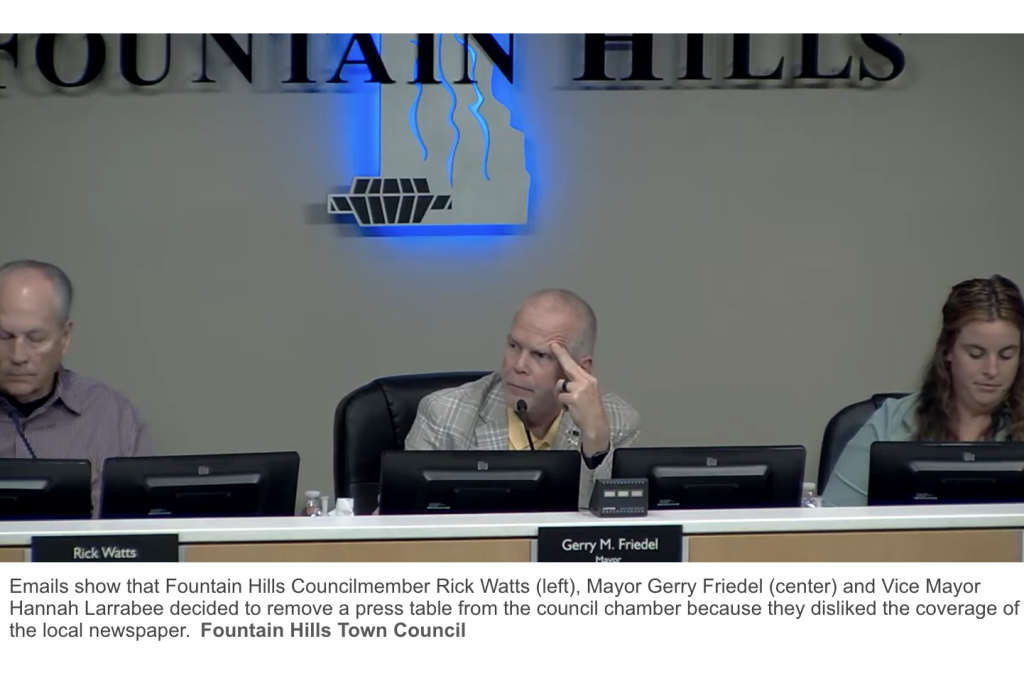
From Phoenix New Times:
“A few months ago, President Donald Trump created a First Amendment firestorm by barring the Associated Press from certain events because the outlet declined to refer to the Gulf of Mexico as the ‘Gulf of America.’ In Arizona, a similarly petty battle is playing out over the freedom of the press.
“In the Valley town of Fountain Hills, a right-wing contingent of the town council removed a press table — primarily used by the local Fountain Hills Times Independent newspaper — because those councilmembers did not like the tone of the paper’s coverage. The paper can still cover town council meetings but must sit among the crowd.
“The reason for the change was revealed in an op-ed from Councilmember Brenda Kalivianakis, which fittingly appeared in the Times Independent. After noticing the table had been removed during a May 6 council meeting, Kalivianakis filed a public records request for emails about the decision. Those emails revealed that at least two councilmembers explicitly tied the table’s removal to their dislike of the paper’s coverage.
“’Frankly, I am fed up with the Times partisan reporting and think it is time to remove the corner ‘reporters’ table,’ Councilmember Rick Watts wrote in one email. ‘If the Times personnel cannot act and report in a factual, nonpartisan manner, without resorting to sensational headlines, reporting on the council and various commissions without obvious bias, then I see no reason for providing any special seating accommodation.’
“An email from Fountain Hills Vice Mayor Hannah Larrabee echoed Watts’ disdain for the local press.
“’I’d like to suggest we remove the media table from the council chambers,’ Larabee wrote. ‘The Fountain Hills Times Independent, especially since the change of ownership, has consistently misquoted the council, reported on items while only seeking statements from one side of the aisle, and on several occasions reported on my job without researching or seeking to understand what I do there.’
“Watts and Larabee did not respond to a request for comment from Phoenix New Times, including about which stories published by the Times Independent had ‘sensational headlines’ or showed ‘obvious bias.’ A quick scroll through news headlines from the outlet didn’t reveal any that are particularly sensational.”
=====
A Second Homeschooling Candidate Resigns from the FHUSD Governing Board
On October 11, 2025, Madicyn Reid resigned her position as a member of the Fountain Hills Unified School District (FHUSD) Governing Board. The resignation was effective immediately and follows the February 20, 2024, resignation of Libby Settle. Both Reid and Setttle homeschooled their children and during their campaigns were vocal critics of the FHUSD.
Settle and Reid, both elected in the November 6, 2022 General Election, appeared to embrace many of the concerns about public education voiced by Moms for Liberty (M4L). Although M4L describes itself as a national “parental-rights advocacy group” its mission appears to be undermining financial support for public education through the promotion of school-choice policies, vouchers and education savings accounts, while at the same time, transforming the curricula and policies of those schools able to withstand the loss of funding, to comport with their ultra-conservative vision.
From its founding in 2021, M4L has revealed itself as a leader in the culture wars. Initially, focused on Covid related mask mandates and school closures, the group shifted to efforts to divert much needed revenue from public education and assume control over school curricula and policies.
M4L has supported removing curricula addressing sexual orientation and gender identity and systemic racism and racial inequality. M4L has attacked policies supporting the principles of diversity, equity and inclusion in public instruction and has led the charge in removing books from public school libraries they deem to culturally inappropriate.
“They really are seeking to undermine public education holistically and to divide communities,” said Rachel Carroll Rivas, deputy director for research, reporting and analysis at the Southern Poverty Law Center.
In 2022, when Reid and Settle were elected, M4L was intent on gaining control of the governing boards of public schools throughout the country by endorsing and supporting candidates that shared their views. This effort was successful. It was reported that in 2022, more than half of the 500 M4L endorsed candidates for school boards won their elections. https://whyy.org/articles/election-2024-moms-for-liberty/ Since that time M4L’s influence on voters appears to have diminished. In 2023 approximately one-third of the organization’s endorsed candidates were elected and that downward trend appears to be continuing, due in signifciant part to the organized efforts by Teachers’ Unions and LGBTQ+ Advocacy Groups to oppose their efforts. https://www.the74million.org/article/moms-for-liberty-has-lost-ground-at-the-polls-but-it-still-wields-influence/
With Reid now out of the picture, it will be up to Maricopa County School Superintendent Shelli Boggs to fill the vacancy on the FHUSD Governing Board. Applications to fill the vacancy were due on December 1, 2025. Applicants must be Arizona residents, live in the district and cannot be FHUSD employees.
The next regular FHUSD Governing Board election will be held during the General Election on November 3, 2026. In 2024, Councilmember Gayle Earle’s, daughter-in-law, Ashley Earle, announced that she was forming a local chapter of M4L. It appears likley, that in the coming months, M4L will recruit and support candidates to fill the vacant seats on the FHUSD Governing Board . We will be watching.
Councilmember McMahon Rebukes Move to Restrict Public Participation
Fountain Hills Times Independent, Nov. 19, 2025: “In a chaotic discussion wherein Mayor Gerry Friedel had Sheriff’s deputies clear the council chamber of the audience, Fountain Hills Town Council voted 5-2 to remove open public comment and personal councilmember updates from future agendas. The action took the form of an amendment to the council Rules of Procedures on the advice of Town Attorney Jennifer Wright. Wright said she advised the council to end the practice or suspend the rules for six months due to a legal notice of claim from resident Beth Culp.”
Councilmember Peggy McMahon, who along with Councilmember Brenda Kalivianakis, were in the minority, voting against the removal of public comment. McMahon put forth a strong argument during the meeting against eliminating Call to the Public and protecting residents’ right to speak, but this was a council majority that we believe arrived that evening with the intent to vote as a bloc — shutting down voice — and carried it out despite numerous speeches from residents that made powerful cases for protecting Call to the Public voice. We share the transcript of Councilmember McMahon’s opposition to Agenda Item 9g below:
=============================================================
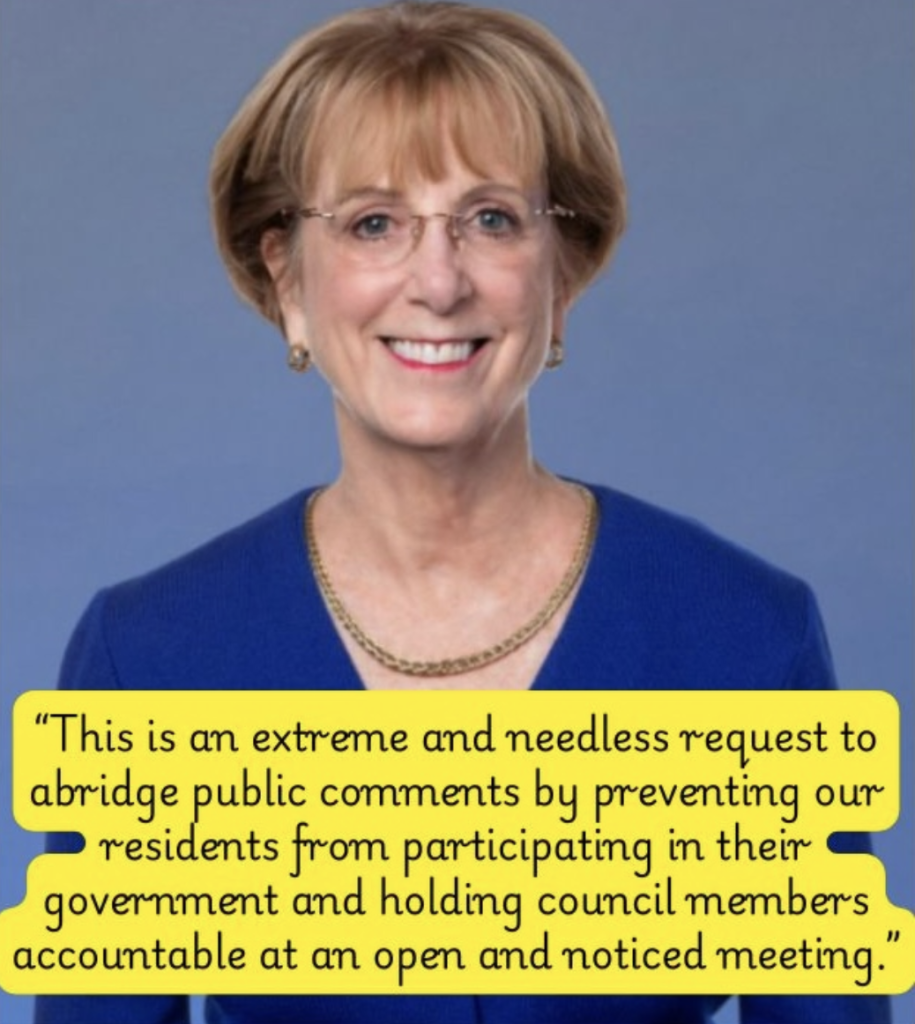
THE RULES of procedure have been revised by this council in April of this year and a few times by the majority on the previous council, that included removing our code of ethics and the ability of our residents to file legitimate complaints against council members for violation of ethics. All done without shutting down Call to the Public or councilmember reports.
Call to the public enables our community members, and others, to stand before council and participate in their government by communicating their concerns in person, even when making personal attacks against council members that include lies and misstatements and threats of lawsuits. I know, I’ve been repeatedly attacked by ROT numerous times over the years and Skillicorn filed a lawsuit against me clinging to violation of “his” right to free speech. Now, our Town Attorney is suggesting we shut down our constituents’ freedoms of speech.
At the last council meeting, Beth Culp stood before council and respectfully provided notice of her intent to file a lawsuit alleging violations of the Establishment Clause by certain council members and members of the public. Statements that should not have been allowed by the Mayor, yet he did nothing to stop their inappropriate religious statements and Bible quoting, thereby creating the situation we are now faced with addressing tonight. Shutting down Call to the Public and Council reports, as a reaction to that and a resident’s notice of a lawsuit.
Many others have previously stood before council and literally threatened lawsuits, lied, and personally and viciously attacked council members at Call to the Public, and the prior Mayor did not overreact and shut down Call to the Public for nefarious reasons. The prior Town Attorney also never asked to shut it down while he was performing his everyday legal duties to the Town, either.
Further, because a few members of council have intentionally misused the purpose of councilmember reports relating to their council responsibilities, for personal ones or due to their religious beliefs or day job, should not mean all of us on council should be prevented from making our professional reports as working council members. Such statements of participation also do not impede the Town Attorney’s ability to perform her job as Town Attorney and analyze an everyday lawsuit filed by one of our residents.
This is an extreme and needless request to abridge public comments by preventing our residents from participating in their government and holding council members accountable at an open and noticed meeting. This is an unacceptable reaction to someone giving notice of an intended lawsuit alleging unethical conduct of council members. In fact, since the majority on council removed our needed code of ethics and the ability to file ethical complaints, and are now trying to silence Call to the Public, the opposite result will occur. Those who participate in our government through Call to the Public in open meetings will speak to council by the only formal means available to them, filing more complaints with the AG’s office and lawsuits to have their voices heard and hold council accountable. I don’t think this is the result you are seeking.
Even though statutes don’t mandate we have Call to the Public, that shouldn’t matter. We’ve had Call to the Public for years and have not suspended it or removed it, especially for the self-interest reasons stated in the agenda to prevent people from saying things that may not be to your liking. To me, you’re setting the Town up for more complaints and violations of freedom-of-speech lawsuits that we cannot afford.
Lastly, how convenient to obstruct and remove Call to the Public and council statements of interest in an election year, which is so obviously self-serving by the Mayor and the Town Attorney, at the expense of our residents’ right to openly participate in their own government.
No – Our Voice & Right to Speak Is Not a ‘Toy’ to Be Taken
We will describe the meeting exactly as it unfolded. The Tuesday, Nov. 18, Fountain Hills Town Council session was a disorderly spectacle of historic scale.
The council’s majority — the usual suspects — eliminated public speech by dismantling the formal Call to the Public process. They also approved a measure to make English the town’s official language, despite this already being established in the Arizona Constitution. Brought by censured and sanctioned Councilmember Allen Skillicorn, who’s touted Great Replacement Theory — a racist conspiracy theory — on conservative radio, this resolution reflects a type of political symbolism that aligns with white Christian nationalist themes.
Mayor Gerry Friedel, petulant and irascible as ever, again lost his composure — multiple times — halting the meeting and even ordering residents out of the chambers. While it is true that some new or inexperienced leaders need time to grow into their roles, Friedel — endorsed by ROT — continues to deteriorate. He repeatedly demonstrates an inability to work constructively with the public, displays routine impatience and volatility, and shows a persistent incapacity to manage the room with professionalism or decorum.
There is much to dissect from this deeply troubling meeting. Suffice it to say, the Town Council majority once again — and perhaps to an unprecedented level of disrespect — diminished the town of Fountain Hills. One moment in particular underscores this behavior: a clip of Turning Point employee and Councilmember Hannah Larrabee, who voted to silence residents because she rejects fact-based criticism and dissent. She brazenly characterized the Call to the Public speaking opportunity as a “toy” that she was “taking away.”
To the good people of Fountain Hills, your voice scares this Town Council majority. Today, Fountain Hills, its reputation, and community residents are worse off than yesterday. Elections matter. We cannot afford to make the same mistakes.
No One Owes Allen Skillicorn an Apology
By Beth Culp.
During the Call to the Public at the Nov. 4, 2025, Town Council meeting, ROT Chairperson Crystal Cavanaugh again took to the lectern to complain about how unfairly Allen Skillicorn has been treated by Councilwoman Brenda Kalivianakis, the Fountain Hills Times Independent, and unidentified members of the public. According to Cavanaugh, Skillicorn is owed an apology because the criminal charges brought against him were dismissed without prejudice, in exchange for his pleading guilty to a lesser charge.
Cavanaugh is conflating the significance of a dismissal with a determination of innocence. Skillicorn was not found to be innocent. Skillicorn agreed to a plea deal that allowed him to avoid the expense of a trial and the risk of being found guilty of a crime that could have landed him in jail.
Skillicorn is not owed an apology where the surveillance video he recently published on Rumble under the title “Fake Charge Dismissed” proves that on March 5, 2025, he violated A.R.S. § 28-662(A)(1) by leaving and failing to return to the site of an accident.
The statute states that a driver involved in a motor vehicle must “immediately stop the vehicle at the scene of the accident or as close to the accident scene as possible but shall immediately return to the accident scene.”
The “Fake Charges” video shows Skillicorn and the other driver entering a parking lot located approximately 200 feet away from the site of the accident. After spending approximately seven minutes with the other driver, Skillicorn is shown leaving the lot. Another surveillance video from a lot 15 minutes away from the accident shows Skillicorn parking and walking away from his car.
Skillicorn did not wait for the investigating officers at the site or in the immediately adjacent lot. Skillicorn ignored the investigating officer’s messages instructing him to return to the site. He violated the statute and is not owed an apology for fair commentary or impartial, factual reporting.
Gerry Friedel’s ‘Show Me Your Papers’ Moment: Intimidation in the Council Chambers
By Pam Cap.
If you watched the November 4th Fountain Hills Town Council meeting, you would have witnessed chaos once again. Since January, under Gerry Friedel’s lead, our council has appeared clueless and directionless most of the time. Councilmembers yelling over each other. Members unable to make motions correctly. Friedel gaveling only those he disagrees with. But now he is ratcheting up his deplorable behavior.
Friedel interrogated a longtime resident prior to allowing her to speak during the call to public. Demanding to know where she lives? And where she was speaking from? Now, that’s an unusual question. Well, Gerry, she is a longtime resident of Fountain Hills and she is speaking to you from the council chambers. It seemed obvious.
Friedel has never asked anyone from Turning Point USA or the MAGA party about their residency before they spoke before the council. They were welcomed with open arms. But a decade-long resident, open member of the LGBTQ+ community who has spoken before Friedel many other times gets interrogated about whether she lives in Fountain Hills currently or not? Why?
It appears a few things can be true. You decide. The previous call-to-public speakers hurt Friedel’s feelings? Friedel is racist, misogynistic, homophobic, weak, and/or incompetent? In my opinion, all the above.
A strong leader is one who welcomes others’ opinions and ideas. Incompetent leaders are ignorant of the rules and laws. They rely on insults and intimidation. Friedel is leading us to the “Show me your papers!” stage of Project 2025. This is just another example of Friedel challenging and stomping on people’s Constitutional rights. Is this really what residents wanted when they voted for Gerry Friedel?
A little truth bomb for you. No one is required to carry an ID to go shopping or attend a council meeting.
Allen Skillicorn’s War on Truth – and the Bodycam That Exposes It
In the weeks since unprecedented sanctions were levied against him, Fountain Hills Councilmember Allen Skillicorn repeated his patently false claim that the sanctions he was assessed by a Town Council majority were the result of a partisan, political smear campaign orchestrated by a liberal mayor. (See bodycam video involving Skillicorn, a Fountain Hills code enforcement officer, and a Maricopa County Sheriff’s Office deputy.)
If living in an alternate reality in which fallacy is consumed as fact, you are the perfect Skillicorn disciple. But reality and facts still matter, and the law enforcement bodycam video we have included further supports the facts.
In one interview, political action committee Reclaim Our Town (best and most appropriately known as ROT), which endorsed Skillicorn for a seat on the Fountain Hills Town Council, claimed that the ethics charges (which Mayor Dickey did not file) represented retribution “because I defeated her.” In other interviews and in his press release Skillicorn asserted that the ethics charges were motivated by a desire to “silence me.”
Skillicorn has consistently accused his “political enemies” of weaponizing the ethics procedure against him and repeatedly referred to the “phony ethics sanctions.” As to Skillicorn’s illegal pursuit of a Town Code Enforcement Officer (and a former police officer), Skillicorn has claimed that his political signs were stolen and that he had a First Amendment right to pursue the employee with his horn honking and his bright lights flashing. Skillicorn stated that “You guys are really skating on thin ice,” then denies that he acted aggressively in his pursuit of the employee. Skillicorn has also claimed that the rules that apply to setbacks were “secretly changed.”
Viewers should take the opportunity to review this bodycam video and judge for themselves if Skillicorn had been truthful or if, as the Sheriff’s Deputy concluded, he has been lying.
ROT’s Chair Spins Fiction, Not Facts – Skillicorn Broke the Law
Cavanaugh’s call for apologies ignores what Skillicorn’s own “Fake Charges” video proves—that he broke the law.
During the November 4 Town Council meeting, ROT’s Chairperson, Crystal Cavanaugh, once again took to the lectern to make it clear that she has no intention of relinquishing her position as the Town Scold and chief purveyor of disinformation. Again, Cavanaugh took it upon herself to express her most profound displeasure with those who dare to question Allen Skillicorn’s character of ROT’s candidate, or accurately report on his unlawful and unethical conduct.
On this occasion Cavanaugh took it upon herself to again lambast Councilmember Kalivianakis for the following comment she made to the Arizona Republic after the criminal hit-and-run charges against him first surfaced:
“Allen refuses to take responsibility for Allen’s actions, the fact that he would flee an accident scene fits right in line with other things I have noticed about his character.”
Cavanaugh also repeated her condemnations of the Fountain Hills Times Independent for accurately reporting on the facts of the incident as detailed in the records of the Tempe police report.
Straining mightily to inject every word with venom and outrage, Cavanaugh claimed that Skillicorn had been vindicated by the plea agreement negotiated by his lawyer with the Tempe prosecutor. Based on the plea deal that dismissed two charges but required Skillicorn to plead guilty to a lesser “excessive speed” charge, Cavanaugh demanded that Kalivianakis, the Fountain Hills Times, and certain unidentified members of the public issue an apology to Skillicorn.
Skillicorn is not owed an apology where the video evidence he himself recently published on Rumble establishes that on March 5, 2025, he violated A.R.S. § 28-662(A)(1), which provides:
A. The driver of a vehicle involved in an accident on public or private property resulting only in damage to a vehicle that is driven or attended by a person shall:
1. Immediately stop the vehicle at the scene of the accident or as close to the accident scene as possible but shall immediately return to the accident scene.
Within days of the plea agreement, Skillicorn posted a video on the Rumble site titled “Fake Charges Dismissed.” The video begins with Skillicorn’s self-serving and potentially libelous narrative, where he claims that he was vindicated by the plea agreement and accuses the other driver of lying and causing the accident.
The surveillance video, obtained by the other driver’s father and downloaded into the evidence file, shows Skillicorn and the other driver entering a parking lot where they had moved their cars, presumably to avoid obstructing traffic on University Avenue, the site of the accident. After meeting for approximately seven minutes Skillicorn entered his vehicle, and after struggling to start it drove slowly out of the parking lot. Another surveillance video, not featured in Skillicorn’s “Fake Charges” post, established that after leaving the parking lot, Skillicorn drove approximately three blocks where he abandoned his vehicle in a parking lot behind the Tempe MAACO.
Ironically, Skillicorn’s “Fake Charges” video stands as irrefutable proof that he committed the criminal act of failing to return to the scene of an accident. Far from exonerating him, the video establishes that Skillicorn violated A.R.S. § 28-662 when he failed to return to the scene of the accident. The statute provides that a driver involved in a collision involving property damage must immediately stop the vehicle at the scene or as close to the scene as possible. Although driving to an adjacent parking lot is permitted to avoid obstructing traffic, the statute expressly provides that after moving their vehicles to another location, the involved drivers “shall immediately return to the accident scene” to allow for the investigation of the collision and an assessment of fault. Skillicorn did not immediately return to the accident scene on University Avenue as required by law and subsequently ignored five telephone calls made to him by a Tempe police officer demanding that he immediately return to the scene.

Rather than return to the accident scene, Skillicorn found an obscure location where he could abandon his vehicle and avoid interaction with the investigating officers who had been summoned to the scene.
In his video narrative, Skillicorn makes no attempt to explain or justify his failure to return to the scene of the accident when he and the other driver could easily walk back to the accident site and wait for police to arrive. Skillicorn offers no explanation for his failure to follow or even respond to the telephone calls made to him by the investigating officer to return to the scene of the accident. The obvious question is, “why” would he risk criminal liability for failing to return to the scene? What was he afraid of?
In addition to the charge of failing to return to the scene of an accident, Skillicorn was charged with leaving the scene before failure to provide the information required by A.R.S. § 28-663.
In the “Fake Charges” video Skillicorn claims that during his brief encounter with the other driver, he met his obligation to provide the information required by the statute, which includes the vehicle’s registration and his name, address, and telephone. Although the other driver told the police that he and Skillicorn exchanged telephone numbers in the parking lot, Skillicorn did not provide him with his name or address until approximately 15 minutes later, by texting a copy of his driver’s license. There is no evidence that Skillicorn provided his vehicle’s registration before leaving the scene. According to the police report, days after the accident Skillicorn still had not provided the vehicle’s registration.
In the “Fake Charges” video Skillicorn, while coyly dangling his iPhone in front of the camera, claims that the phone contains evidence that he did provide the other driver with the required information before driving away. Skillicorn did not share this evidence with the video’s viewers.
In the “Fake Charges” video Skillicorn also blames the other driver for the accident, claiming that he “didn’t even look” before pulling onto University Avenue. Skillicorn goes on to claim that immediately following the accident the other driver acknowledged fault and apologized, but then suddenly changed his story and “lied.”
Although a driver entering a roadway who fails to yield to oncoming traffic resulting in a collision is presumed to be at fault under A.R.S. § 28-773(A), this presumption does not apply if the driver of the other vehicle is found to have been driving at an unlawful or excessive speed. See, Layne v. Hartung, 90 Ariz. 369 (1962). Although a driver with the right-of-way is ordinarily protected, that right is not absolute.
If a driver’s excessive speed prevents another motorist from accurately judging their approach, the speeding driver loses the benefit of the right-of-way rule. The fact that Skillicorn pleaded guilty to traveling at excessive speed in violation of A.R.S. § 28-701(A) is compelling evidence that he, and not the other driver, was at fault.
The dismissal of the criminal charges does not support Cavanaugh’s or Skillicorn’s proposition that he was vindicated by the plea agreement. The court records indicate the dismissals were without prejudice to refile them.
Under Rule 16.4 of the Arizona Rules of Criminal Procedure, a docket entry stating only that a charge was dismissed is presumed to mean that that the criminal charges were dismissed without prejudice, preserving the prosecutor’s right to refile the charges if warranted by subsequent events.
Skillicorn’s video might be a subsequent event that could prompt a prosecutor to refile the charges to establish that they were not, as he claims, “fake.” Skillicorn would be well advised to take down the “Fake Charges” video and avoid any further charges for excessive speed or reckless driving. He has not been vindicated and no one owes him an apology.
Mayor Friedel Questions Long-Time Resident’s Right to Speak
During the Nov. 4 Fountain Hills Town Council meeting, a decade-long resident, Ms. Villa-Watkins, approached the lectern to deliver remarks during Call to the Public. After politely clarifying that she is from Asia—not South America—following the clerk’s mispronunciation of her name, Mayor Gerry Friedel abruptly questioned her residency.
Exchange:
Friedel: “What town are you in? What town do you live in?”
Villa-Watkins: “I live here. Over a decade.”
Friedel: “Fountain Hills?”
Villa-Watkins: “Yes.”
Friedel: “Currently?”
Villa-Watkins: “What is this question?”
After the meeting, Ms. Villa-Watkins sent an email to Friedel and the full Council, requesting an apology that included the following:
“Yes, I am a Fountain Hills resident. What I did not respond back to you last night is, who did you mistake me for?
“What you DID accomplish last night by questioning my residency in FH, before I was even allowed to speak, was you showed your true colors. And for your future reference, I am an AMERICAN citizen and my father, as well. He served in 3 foreign wars for our country. He is also a purple heart recipient – just in case you have other ulterior motives.”
It is troubling that Mayor Friedel, who entered office amid controversy over his racist and xenophobic social-media posts and later joined the ROT-supported council majority that voted to “ban” DEI, publicly challenged and disrespected the only person of color to address the Council during the meeting.
Mayor Friedel’s Double Standard on Decorum
The Fountain Hills Town Council’s Rules of Procedure 5.2.G5 state in part: “In order to conduct an orderly business meeting, the Presiding Officer shall keep control of the meeting and shall require the speakers and audience to refrain from abusive or profane remarks, disruptive outbursts, applause, protests or other conduct that disrupts or interferes with the orderly conduct of the business of the meeting.”
Under these rules, Mayor Gerry Friedel abruptly shut down audience applause following resident Patty Torrilhorn’s remarks on the separation of church and state and the Council’s Open Meetings Law violations. Yet what unfolded next was less about order than about control. Friedel’s immediate reaction to residents participating in local government was to threaten, “I’ll clear the room.”
This unnecessary escalation could have been avoided with steady leadership and respect for civic engagement. Instead, Friedel once again demonstrated poor judgment, limited composure, and a pattern of selective enforcement. When applause aligns with his agenda, he lets it stand. When it challenges him, he cracks down.
The inconsistency is striking—and unacceptable for a presiding officer who should model impartiality.
*Statement of Participation: As a couple of speakers adroitly also pointed out, the Town Council Meeting Agenda — Statement of Participation — reads, “It is also requested that applause be kept to a minimum….” When Friedel threatened “I will clear the room” and an audience member asked, “For clapping,” Friedel said “Yes. It is not allowed.”
THAT, IN FACT, IS NOT TRUE, MAYOR FRIEDEL.
Applause is, per the Statement of Participation, allowed.
STOP making your own subjective rules, Mayor Friedel. Stop bullying. Stop censoring speech. Fountain Hills deserves leadership that treats every voice with fairness and dignity.
Fountain Hills Officials Punished a Paper for Coverage They Don’t Like
Right-wing town officials decided to remove a table for the local paper in a Trumpian retaliation over negative coverage.
“A few months ago, President Donald Trump created a First Amendment firestorm by barring the Associated Press from certain events because the outlet declined to refer to the Gulf of Mexico as the ‘Gulf of America.’ In Arizona, a similarly petty battle is playing out over the freedom of the press.
“In the Valley town of Fountain Hills, a right-wing contingent of the town council removed a press table — primarily used by the local Fountain Hills Times Independent newspaper — because those councilmembers did not like the tone of the paper’s coverage. The paper can still cover town council meetings but must sit among the crowd.
“The reason for the change was revealed in an op-ed from Councilmember Brenda Kalivianakis, which fittingly appeared in the Times Independent. After noticing the table had been removed during a May 6 council meeting, Kalivianakis filed a public records request for emails about the decision. Those emails revealed that at least two councilmembers explicitly tied the table’s removal to their dislike of the paper’s coverage.
“’Frankly, I am fed up with the Times (sic) partisan reporting and think it is time to remove the corner ‘reporters’ table,’ Councilmember Rick Watts wrote in one email. ‘If the Times personnel cannot act and report in a factual, nonpartisan manner, without resorting to sensational headlines, reporting on the council and various commissions without obvious bias, then I see no reason for providing any special seating accommodation.’
“An email from FountainHills Vice Mayor Hannah Larrabee echoed Watts’ disdain for the local press.
“’I’d like to suggest we remove the media table from the council chambers,’ Larabee wrote. ‘The Fountain Hills Times Independent, especially since the change of ownership, has consistently misquoted the council, reported on items while only seeking statements from one side of the aisle, and on several occasions reported on my job without researching or seeking to understand what I do there.’
“Watts and Larabee did not respond to a request for comment from Phoenix New Times, including about which stories published by the Times Independent had ‘sensational headlines’ or showed ‘obvious bias.’ A quick scroll through news headlines from the outlet didn’t reveal any that are particularly sensational.”
=====
Read the Phoenix New Times story in its entirety.
Skillicorn Skates
On Oct. 30, 2025, Councilmember Allen Skillicorn sat slumped and alone in the waiting room adjacent to the three tiny courtrooms housed in the Tempe Municipal Courthouse. After more than nine months of unexplained and unwarranted continuances, the day had finally come for Skillicorn to face the consequences for his unlawful act of fleeing the scene of an accident.
Although Skillicorn was visibly diminished and clearly chagrined by the presence of an interested observer, as it turned out he had nothing to worry about. The fix was in and Skillicorn skated.
After a barely audible sidebar exchange with the City Prosecutor, Esteban Gomez, recently appointed Municipal Judge Kerry Rait approved a plea deal that included the following provisions:
• Skillicorn would plead guilty to a new charge, added by the prosecutor that day, to facilitate a deal: the civil offense of traveling at a “speed greater than reasonable and prudent for conditions” in violation of A.R.S. § 28-701(A).
• The prosecutor would dismiss the more serious charges of fleeing the scene of an accident in violation of A.R.S. § 28-663(A)(1) and failure to provide information in violation of A.R.S. § 28-663 (A)(2); and
• Skillicorn would pay a $250 fine and $246 in court costs for a total outlay of $496.
There is no legitimate explanation for the prosecutor’s recommendations or Judge Rait’s leniency.
According to data collected and maintained by the Maricopa County Attorney’s Office and the Arizona Judicial Branch’s case disposition reports, in Arizona, approximately 3,000 to 3,500 criminal actions involving “leaving the scene” of an accident are filed annually. Approximately 95 percent of these cases are resolved through plea agreements. It is not uncommon for the agreements to include guilty plea to a lesser criminal offense, but it is extremely rare for the prosecutor to negotiate a plea deal where the defendant avoids all criminal liability by pleading guilty to a civil traffic violation.
Dismissal of all criminal charges following the prosecution’s addition of a civil traffic citation occurs in less than five percent of the cases statewide, and less than two percent of the cases filed in the Maricopa County Municipal Court. This deviation may be justified where there are shortcomings in the evidence and no ongoing public safety concerns.
Here, the charges were fully supported by an investigation that included the other driver’s statement, a photograph of Skillicorn driving away from the scene, and video footage of him abandoning his damaged vehicle in a nearby parking lot and walking rapidly away from the scene.
There is no evidence to rebut the investigator’s belief expressed in the police report:
“Based on the difficulty it took for Skillicorn to start the vehicle, the short distance he drove away, and the fact that he fled the vehicle on foot after he parked, it is believed that he did not intend at any point to have police contact.”
In addition, there can be no question that Skillicorn’s reckless driving remains a public safety concern. On April 25, 2025, just six weeks after he was involved in the Tempe hit and run, the Scottsdale Police Department charged Skillicorn with reckless driving and operating an unregistered vehicle. These charges resulted in a criminal prosecution, assessment of a hefty fine, and mandatory attendance at “driver’s school.” In comparison, the plea agreement negotiated by the Tempe prosecutor and rubber stamped by Judge Rait, for far more serious offenses, resulted in little more than a tap on the wrist.
It does not appear that before accepting the plea agreement Judge Rait considered a Presentence Investigation Report, that should have been prepared, that would have included Skillicorn’s reckless driving history. It also does not appear that Judge Rait considered any victim impact statements that the prosector was obligated to request.
Whether attributable to dereliction of duty, deliberate indifference, or nefarious motives, the plea deal transformed a crime long regarded as one involving moral turpitude into nothing more than a minor traffic infraction.
The Skillicorn plea raises serious concerns about the equal application of justice. When the punishment imposed on elected officials dramatically diverges from prosecutorial and judicial norms, public trust is eroded.
Public opinion should not be affected by Skillicorn’s sweetheart deal. A dismissal of criminal charges is not equivalent to a determination that Skillicorn was innocent. Through the eyes of voters Skillicorn can and should be viewed not only as a self-proclaimed “chaos agent,” who has repeatedly embarrassed and disgraced our town, but as a criminal.
From Park Place to the Town Attorney: A Council in Disarray
Once again, our council is not doing itself any favors.
Led by a seemingly confused Mayor Friedel, after extended discussion on an extension of the building permits for Park Place Phases II and III, the council finally voted on a motion to approve with a stipulation to “resolve” an issue(s) in the project Development Agreement. But no one was able to say what needs to be resolved. They even argued about the term “resolve” versus “amend.”
The applicant threatened a lawsuit. History was distorted. The Chamber president urged passage without amendment. And, as has become the standard allegation, it was the previous mayor who apparently caused the problems! After motions, amendments, friendly changes, points of order, thoughts of executive session for attorney advice and, of course, a call for question, an amended motion finally passed, but not unanimously. What’s next for Park Place? Fences up or down? Lawsuits filed? Distortions of history? Who will be blamed next?
And then the council revisited the town attorney procurement/contract. Allegations were put on the table for discussion by a councilperson. Oh my, what a mess ensued as council engaged in a spirited discussion. There were points of order, gaveled-down councilpersons, councilpersons arguing over each other, threats from the mayor to have a citizen removed, and the mayor’s statement: “That’s enough!”
And then there was a resident (guess who) blaming previous Mayor Dickey for the mess – again, how convenient – when it was under Mayor Kavanagh the previous attorney/firm was hired (a famously conservative firm – that little tidbit got left out!). Tenured councilpersons and staff sat silent when history was again distorted. Shameful.
Watch the video of Sept. 2 (fountainhillsaz.portal.civicclerk.com/event/90/media). The Times Independent account didn’t do the meeting justice.
Where does this elected group go next?
‘Great Replacement Theory’ Is a ‘White-Nationalist Conspiracy’; Do Not Normalize It
Allen Skillicorn – March 26, 2024–Garret Lewis radio show: “The politicians and the bureaucrats…I like to call them “corruptocrats, they came up with this idea that they’re going to start building lower income, high-density, urban housing to replace the population. So literally they are going to have a GREAT REPLACEMENT THEORY here in Fountain Hills….”
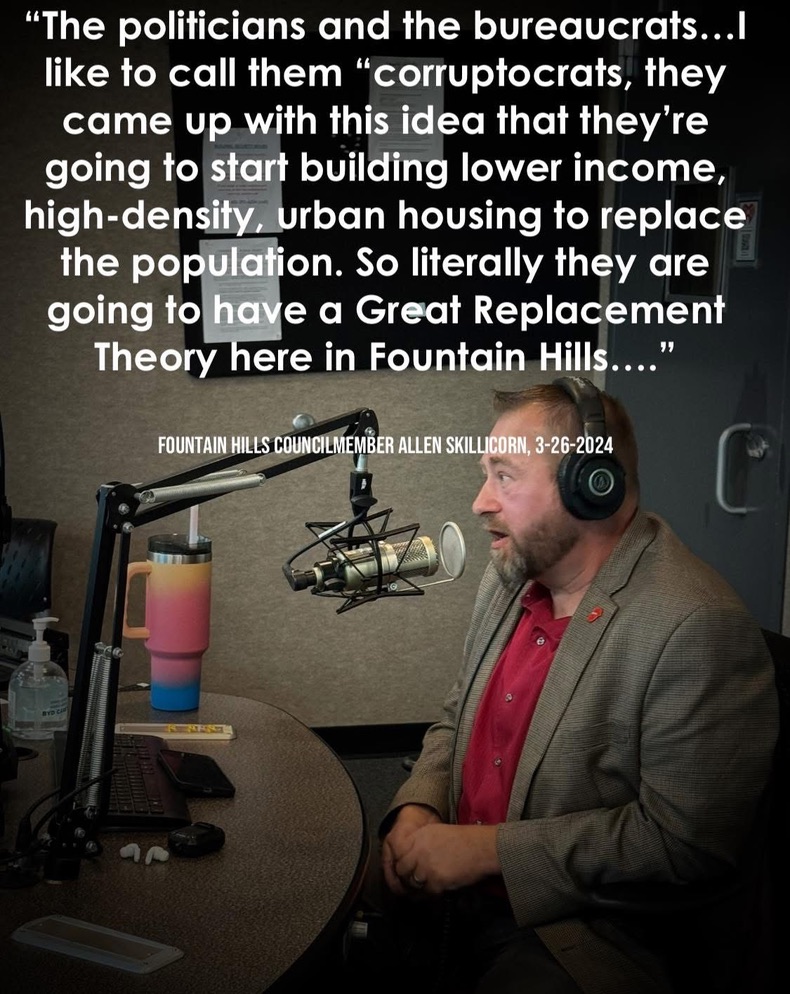
Charlie Kirk – March 1, 2024–Charlie Kirk Show: “The GREAT REPLACEMENT strategy, which is well under way every single day in our southern border, is a strategy to replace white rural America with something different.”
======================
We called on artificial intelligence to provide us with its opinion on the Great Replacement Theory, specifically the comment made by Fountain Hills Councilmember Allen Skillicorn on the Garret Lewis radio show. Here is what it had to say:
“A statement like this — invoking the ‘Great Replacement Theory’ — is highly concerning coming from an elected official. That phrase refers to a racist and xenophobic conspiracy theory suggesting that elites or governments are deliberately replacing white populations with immigrants or minorities. It has inspired multiple acts of violence, including mass shootings in places such as El Paso and Buffalo.
“When an elected representative uses that language publicly, it has several implications:
“1. Normalization of Extremist Rhetoric
Using ‘Great Replacement’ in civic discourse lends legitimacy to an idea that originated in white-nationalist movements. Even if the speaker claims it’s metaphorical or about policy (like housing or zoning), the phrase carries a violent, racially charged history that cannot be separated from its extremist context. Elected officials have an ethical duty to avoid rhetoric that emboldens hate or fear of demographic change.
“2. Distortion of Public Policy Issues
Tying local housing or zoning discussions to conspiracy language misinforms the public. Affordable or higher-density housing is an urban-planning topic, not a population-replacement plot. Framing it as such polarizes citizens, undermines fact-based dialogue, and stigmatizes residents who might benefit from inclusive development.
“3. Impact on Community Trust
In a small town like #FountainHills, comments like this can erode trust between leaders and residents. They alienate people of color, renters, and lower-income households, and create fear that civic leadership is guided by prejudice rather than public interest. That is corrosive to civic cohesion, economic diversity, and the town’s reputation.
“4. Accountability and Response
Constituents can legitimately expect clarification, a public apology, or repudiation of extremist rhetoric. Responsible community leaders should reaffirm inclusive values and separate legitimate zoning debates from language associated with racial conspiracy theories.
“Words matter—especially from those elected to lead. When an official invokes the so-called ‘Great Replacement Theory,’ they are not engaging in civic debate—they are echoing a white-nationalist conspiracy that has fueled real-world violence. Housing policy and population diversity are legitimate topics for community discussion, but framing them through the lens of a racist myth is dangerous, misleading, and beneath the dignity of public office.”
When was the last time you heard Allen Skillicorn issue a public apology for anything? Ever? When Skillicorn’s sanctions were removed, we even heard ROT-supported councilmembers use the language “time served” when eliminating Skillicorn’s sanctions. Now, Mr. Skillicorn is pushing a statue to be named for Charlie Kirk, who also pushed the ugly, dangerous Great Replacement theory.
Fountain Hills deserves leadership that uplifts facts, inclusion, and solutions—not fearmongering. Our town’s strength has been its sense of community and shared respect for all residents. We must expect better from anyone who holds the public trust. And we must reject a statue that embodies prejudice and inflames division.
Just Say No to a Statue of Charlie Kirk in Fountain Hills
By Faryl Palles. After failing to get support for renaming the Fountain Hills Community Center as tribute to Charlie Kirk, Allen Skillicorn successfully moved to get the construction of a statue of Kirk on a future agenda. Hannah Larrabee seconded the motion, followed by Gayle Earle giving the required third vote.
I have polled the community in three different Fountain Hills Facebook groups and I can tell you that there is immediate astonishment, disgust, anger and refusal in response to the idea of a Charlie Kirk statue…and this without any discussion of who pays for the “tribute.”
Councilmember Skillicorn argued for the community center renaming in the Fountain Hills Times Independent by saying “we owe it to Charlie.” Who is this “we” Mr. Skillicorn is using to bolster his agenda? That’s, in my opinion, the question.
Transparency Means Access — for All Residents, Not a Chosen Few
By Kathy Florence.
I am both concerned and angered by the fact that Mayor Friedel now posts his “Friedel Friday” video updates on issues of interest and importance to residents, seemingly only on the pages of private Facebook groups. The administrators of these groups are known to have banned and blocked residents, like me, who have questioned or challenged the mayor’s representations and statements.
Prior to the election the videos were posted on Friedel’s public social media pages and YouTube. Now, they are published on the pages of private groups where the administrators exercise control over the residents who will be allowed to view the content and potentially delete critical commentary.
This shift to posting the Friedel Friday videos on the pages of private groups constitutes another violation of the Mayor’s “full transparency pledge,” but I believe it also constitutes a violation of the First Amendment rights of the residents who have been blocked and banned.
Last year, the Supreme Court held that when public officials use social media to communicate about matters of community concern, they must ensure that all of their constituents have access to and an equal right to comment on those communications. Allowing private surrogates to control the flow of information and suppress dissent is, in my opinion, a violation of the First Amendment Rights of residents who do not have access to these forums.
The First Amendment protects the right of every resident to receive, evaluate and respond to information provided by the mayor. He could not, consistent with his obligation to uphold the Constitution, deliver the State of the Town address in a private meeting to a pre-screened audience. When public officials use digital spaces to communicate on matters of public interest, they must ensure access for all.
A Tribute Worth Making: Ban Together for Change
By Robyn Heimbuch.
The Charlie Kirk Memorial Freedom Center?
I think we can do better and finally address gun violence in America; it’s way past time. Call it whatever you want in Charlie’s memory. “Ban Together 4 Charlie.” “Charlie’s Memorial End to Gun Violence Act.” For our children, for our families. We, the American people, support gun legislation (58% according to PEW). You know who doesn’t? Politicians, lobbyists and the NRA.
We have an American problem: 10,745 gun deaths since Jan. 1, 2025, 10 mass murder incidents that resulted in 310 deaths. We need common-sense gun legislation that the wide political spectrum in the middle can agree upon. We need to tune out the noise and get it done. It is way past time!
That’s how you honor Charlie Kirk, Melissa Hortman, John Hortman, Mark Hoffman, Yvette Hoffman, the family dog and all tens of thousands of children who are victims of gun violence, whether through loss of their life or of their parent(s). That’s a tribute I can truly support.
When MAGA Cries ‘Communism,’ It’s Projection — Even Here in Fountain Hills
By Don Scott.
MAGA conservatives toss around words like “communist” and “Marxist” the same way they fling “woke,” “DEI,” or “patriot.” It’s either projection — sticking these labels on political opponents — or co-opting them to twist meaning. In a recent Times opinion under the curious byline “Rick Dime,” the writer invoked “neo-Marxist” and “communism” in yet another attack on Democrats, all while hypocritically bemoaning “name-calling.” These terms are fearmongering insults better suited for Fox News, where lies cost $788 million, or Newsmax, where lies cost $67 million.
MAGAs love to call their fellow Americans “communists.” But step back, and the irony is clear. When communism was put into practice in the 20th century, it was known for:
• One-party control branding opponents as illegitimate.
• Suppression of dissent and attacks on the free press.
• Consolidation of power into a single leader’s hands.
• Personality cults demanding loyalty to the leader over country.
Sound familiar? These are today’s MAGA tactics. From silencing critics and undermining the press, to loyalty tests and attempts to concentrate presidential power under Project 2025, MAGA is borrowing pages straight from the authoritarian playbook.
We’ve seen the same locally — demeaning journalists as enemies of the people, and the Fountain Hills Town Council removing the Times’ longstanding media table in a symbolic subversion of press access. When a current councilman recently shared to social media a post from a right-wing commentator mocking the “Arizona Repugnant” for cutting journalists, Gerry Friedel quipped: “How about The Depressing Times next.” Another broadside at our local paper.
When MAGA zealots throw around the word “communism,” remember, it’s not a description of their opponents. It’s a projection of their own behavior. The irony is that MAGA accuses others of “communism” while embracing authoritarian tactics that mirror the very regimes they claim to despise.
Have you no sense of decency, sir?
Inappropriate Council Remarks Overshadow Stellar Student Awards
By Tiana Torrilhon-Wood.
My family and I attended the Stellar Student award ceremony in honor of my child’s accomplishments. What should have been a routine and celebratory evening was deeply overshadowed by the tone and content of remarks made by members of the town council.
Instead of focusing on the students and their achievements or on town business and activities, the open remarks included graphic descriptions of the recent murder of Charlie Kirk, demonization of political groups and sermonizing about religion and ideology. These statements were angry, divisive and completely inappropriate for a ceremony where young children were present.
In addition, my autistic son was physically touched and pressured by an audience member to force him to stand during a prayer. No child should be subject to physical coercion at a public event, nor physically forced to participate in religious rituals. I can’t help but feel that the rhetoric of the town council encourages such behavior.
As a parent, I left the event feeling unsafe and profoundly uncomfortable. The political and religious tone taken by elected officials was not only irrelevant to town business, it undermined the inclusive and respectful environment that all Fountain Hills families should be able to expect at civic celebrations.
I urge the town council and mayor to reflect on the responsibility of public officials to foster unity, respect and safety at community events — especially those honoring children. The use of these occasions to advance partisan, religious or divisive agendas is harmful and unacceptable. To describe violent events in graphic detail in front of children and then just leave us as parents to explain this to them is beyond egregious.
My hope is that future events can return to their intended purpose: celebrating the achievements of our children in a manner that is supportive, welcoming and safe.
The Mayor’s MCSO Savings Claim Doesn’t Match the Record
By Beth Culp.
A letter to the editor, submitted by Mayor Friedel to the Fountain Hills Times, was titled “Confusion over MCSO contract savings in Fountain Hills.” In his letter Mayor Friedel, in a purported effort to clear up the confusion, claimed, “My meetings with Sheriff Jerry Sheridan resulted in year-over-year savings of 6%, or approximately $370,000.”
Friedel’s claim that his meetings with Sheridan saved the town $370,000 is not supported by the official correspondence explaining the reduction.
MCSO’s contract with Fountain Hills, andother municipalities that contract for its services, is based on a “cost recovery” model. Essentially, the MCSO recovers the direct cost it incurs in providing law enforcement services and assesses an additional 3% to recover its indirect administrative costs.
Under the terms of the Agreement in February of each year MCSO must advise the municipalities it serves of the amount they will be assessed for law enforcement services during the upcoming fiscal year. Adjustments to the amount paid for law enforcement services is based on MCSO’s past and projected costs.
Through correspondence dated Feb. 5, 2025, the MCSO advised the Fountain Hills Town Manager that the FY 2026 “Law Enforcement charges” would be $5,759,468.37, a $373,243.21 decrease from FY 2025. The reduction was largely attributed to a decision made by the Maricopa County Board of Supervisors to pay down unfunded pension liabilities under the Arizona Public Safety Personnel Retirement System, resulting in lower personnel costs for MCSO and a corresponding cost reduction for Fountain Hills and other municipalities (including Carefree and Cave Creek) it serves. The reduction was also attributed to vacancy credits, negotiated into the contract during Mayor Dickey’s administration, resulting at the time, in a $722,000 reduction.
The mayors of Carefree and Cave Creek did not claim credit for this contractual adjustment. Why did ours?
From Park Place to the Town Attorney: A Council in Disarray
By Al Ronca.
Once again, our council is not doing itself any favors.
Led by a seemingly confused Mayor Friedel, after extended discussion on an extension of the building permits for Park Place Phases II and III, the council finally voted on a motion to approve with a stipulation to “resolve” an issue(s) in the project Development Agreement. But no one was able to say what needs to be resolved. They even argued about the term “resolve” versus “amend.”
The applicant threatened a lawsuit. History was distorted. The Chamber president urged passage without amendment. And, as has become the standard allegation, it was the previous mayor who apparently caused the problems! After motions, amendments, friendly changes, points of order, thoughts of executive session for attorney advice and, of course, a call for question, an amended motion finally passed, but not unanimously. What’s next for Park Place? Fences up or down? Lawsuits filed? Distortions of history? Who will be blamed next?
And then the council revisited the town attorney procurement/contract. Allegations were put on the table for discussion by a councilperson. Oh my, what a mess ensued as council engaged in a spirited discussion. There were points of order, gaveled-down councilpersons, councilpersons arguing over each other, threats from the mayor to have a citizen removed, and the mayor’s statement: “That’s enough!”
And then there was a resident (guess who) blaming previous Mayor Dickey for the mess – again, how convenient – when it was under Mayor Kavanagh the previous attorney/firm was hired (a famously conservative firm – that little tidbit got left out!). Tenured councilpersons and staff sat silent when history was again distorted. Shameful.
Watch the video of Sept. 2 (fountainhillsaz.portal.civicclerk.com/event/90/media). The Times Independent account didn’t do the meeting justice.
Where does this elected group go next?
Dark Words Have No Place in a Student Celebration Nor in Local Leadership
By Don Scott.
Stellar Students were finally recently recognized by the Town Council, but only after 10 minutes of dark, disturbing language. Before preschoolers and their families were honored, they heard repeated references to darkness, demons, hell, a shooter, murder, assassination, death, hatred, and rage. The majority came from Turning Point employee Councilmember Larrabee, seemingly oblivious to the young children in front of her. In contrast, Councilwoman Earle used her time for a moment of silence. Mayor Friedel later quipped, “Let me be the downer now,” as if he hadn’t noticed what children just endured while waiting to be recognized for their kindness and leadership.
Councilmember Skillicorn pressed his agenda against people experiencing homelessness, declaring “the problem has gotten worse,” despite an earlier MCSO report noting “no uptick” in calls. Skillicorn, no stranger to law enforcement issues himself, must have hoped the public wasn’t paying attention.
Even more troubling, Councilmember Larrabee described homelessness as “a choice,” tied to mental illness and drug use. She suggested the Council act like a “parent” and impose “ramifications for urban camping,” saying it needs to be “scarier to not do it” so people will accept shelter. Her words echo those of her employer’s founder, who said, “Every single one of them has mental problems or drug disorders,” and “Homeless is a choice.”
Research tells a different story. Homelessness is driven by poverty and a shortage of affordable housing, compounded by unsafe shelters, family separation, or restrictive rules—not by “choice.” Evidence shows Housing First and supportive services reduce homelessness and save taxpayer dollars. Punishment deepens hardship.
Our community—especially its children—deserves dignity, compassion, and proven solutions. No child should hear speeches filled with demons, death, and hatred, and no family should face fear-based policies criminalizing those struggling in poverty. Fountain Hills deserves better leadership and values.
What Has This Council Actually Accomplished?
By Sherri James.
In a recent letter to the editor, a resident claimed that Jerry(sic) Friedel has accomplished a lot, but then she didn’t list a single accomplishment.
She also said that our last mayor never reached out to our community!
Under Mayor Dickey’s leadership, the council and staff worked hard to maintain and improve the town while keeping its residents safe. Their accomplishments are too numerous to list here but include: Increased the number of crosswalks and created “sfety corridors. Established our own Fire Department. Expanded Fountain Hills Boulevard and parking for the Botanical Garden. Improved the intersection of La Montana and Avenue of the Fountains with a roundabout. Remodeled Centennial Circle. Painted and remodeled municipal buildings. Town-wide street repaving and sidewalk infill.
Also, LED lighting of the fountain and improvements to the fountain pumps. Four Peaks playground improvements. Murals on electrical boxes. Electric vehicle charging stations. A total revamp of Golden Eagle Park to improve flood management. Improvements to the Splashpad and Skatepark. Added picnic tables, shade structures and restrooms to Fountain Park. Oversaw the creation of the International Dark Sky Discovery Center, the Fountain Hills Medical Center and many new residential developments. Began saving for a new Fountain Lake liner.
In addition to her daily meetings with residents and constant replies to residents’ concerns via email and phone, she also represented the town on the Mayors’ Education Roundtable; the Maricopa Association of Governments; the League of Arizona Cities and Towns; the East Valley Mayors; the Greater Phoenix Economic Council and more.
You can see how people are disappointed in the current mayor, who chairs meetings that are chaotic and undisciplined, often failing to follow his own Rules of Procedures. This council has done nothing but rehash issues that previous councils had already decided.
What accomplishments?
From Press Table to Public Insults: The Mayor’s War on Local Journalism
It seems like Gerry Friedel — the self-styled “transparency” mayor (sarcasm) — continues to hold a grudge against our community news outlet, the Fountain Hills Times Independent.
Many likely remember the juvenile action against the Times Independent when Mayor Friedel and Councilmembers Watts and Larrabee, according to a public records request, had the paper’s press table remove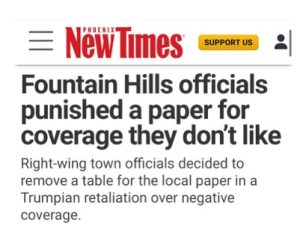 d from Council meetings in May. Town Manager Rachael Goodwin stated at the time: “There was a discussion and a directive from the mayor and several other councilmembers with the request to remove the table from the space,” Goodwin said. (Read the full story here: https://www.phoenixnewtimes.com/…/fountain-hills….)
That apparently wasn’t enough for Friedel. In a private Facebook group, under a post celebrating the  ousting of a progressive journalist at the Arizona Republic, he took aim at our own community paper, commenting: “How about The Depressing Times next.”
Whether mocking the Times Independent outright or endorsing the silencing of progressive voices, the message was clear: this mayor would rather see our local paper diminished than respected for its service to the community.
Ethics Complaint filed against Friedel.
Beth Culp
15429 East Richwood Avenue
Fountain Hills, AZ 85268
Subject: Ethics Violations Committed by Mayor Gerry Friedel
Mayor Gerry Friedel has violated the Code of Ethics found in the Town of Fountain Hills Rules of Procedure by making misleading and false statements in an effort to take undeserved credit for the 6% reduction in the amount Fountain Hills residents will pay for police services in FY 2026. The misleading and false statements include the following, made by Friedel in a letter to the editor of the Fountain Hills Times, published on February 21, 2025: “My meetings with Sheriff Jerry Sheridan resulted in year-over year savings of 6% or approximately $370,000.”
This statement was a complete fabrication, made with the intent to affirmatively mislead the residents of Fountain Hills.
As set out in greater detail below, the Maricopa County Sheriff’s Office (“MCSO”) provides police services to Fountain Hills, pursuant to an Intergovernmental Agencies’ Service Agreement (“the Agreement”). Throughout his mayoral campaign Friedel criticized his opponent, former mayor Ginny Dickey, for negotiating an agreement that was unfavorable to Fountain Hills. Friedel claimed that the Town had been overcharged for the police services provided under the Agreement and, as a result, MCSO owed the Town hundreds of thousands of dollars. During the campaign Friedel also announced his intent to renegotiate the terms of the contract if he was elected.
In campaign advertisements Friedel pledged that, if elected, he would meet with the new MCSO Sheriff within the first 100 days of his administration, presumably as a first step in recovering the alleged overpayments and renegotiating the Agreement.
On February 5, 2025, Jim Prindiville, the MCSO’s Chief Financial Officer, advised the Fountain Hills Town Manager that primarily due to a decision made by the Maricopa County Board of Supervisors in 2023, to pay down unfunded pension benefits for sworn officers, Fountain Hills would be charged approximately 6% less for law enforcement services during the upcoming fiscal year.
One day later, on February 6th Friedel, suggested in a meeting with constituents and in a press release, that following his meeting with Sheriff Sheridan, the MCSO responded to the concerns expressed during his meeting with Sheridan, by reducing the amount that Fountain Hills would pay for police services by 6%.
On February 21, 2025, in a purported effort to clear up the “confusion” about the reduction Friedel claimed that his meetings with Sheriff Sheridan “resulted in year-over year savings of 6% or approximately $370,000.
Many residents of Fountain Hills are still operating under the mistaken belief that Friedel’s meeting with Sheriff Sheridan saved taxpayers $370,000. By attempting to and succeeding in misleading the residents of Fountain Hills Friedel breached his ethical obligations as codified in the Fountain Hills Town Code.
All of the ethical violations described below have either been
Committed or discovered by me within the past 90 days.
MAYOR FRIEDEL’S VIOLATIONS OF THE CODE OF ETHICS BY FALSELY CLAIMING THAT HIS MEETINGS WITH SHERIFF JERRY SHERIDAN SAVED FOUNTAIN HILLS TAXPAYERS $370,000.
Applicable Provisions of the Code of Ethics
The Code of Ethics is found in Section 8 of the Fountain Hills Rules of Procedure.
The preamble to the Code states in relevant part: “The citizens of Fountain Hills are entitled to have a fair, ethical, and accountable government, which has earned the public’s full confidence. In keeping with the Town of Fountain Hills commitment to the effective functioning of government, public officials, both elected and appointed, shall comply with both the letter and spirit of the laws and policies affecting the operations of government; be independent, impartial and fair in their judgments and actions for the good and not for personal gain. (emphasis supplied).
Friedel violated both the letter and spirit of the Code of Ethics by falsely representing that his meetings with Sheriff Sheridan resulted in a $370,000 reduction in the amount paid by Fountain Hills taxpayers for law enforcement services. In making these misrepresentations and false statements, Friedel sought to and did lead members of the public to believe that he had fulfilled his campaign promises to recoup alleged overpayments and renegotiate the terms of the Agreement.
Section 8.4 of the Code of Ethics obligates every councilmember to: “be dedicated to the highest ideals of honor, ethics and integrity in all public and personal relationships.”
Friedel’s act of falsely taking credit for the $370,000 reduction of the cost of police services undeniably demonstrated a profound lack of honor, ethics, and integrity.
The most fundamental obligation of a public official is to be honest in his communications with the public, particularly as to matters of public interest and concern. For the past 18 months the MCSO Agreement has been a matter of keen public interest, based primarily on the criticisms levelled by Friedel and his supporters.
Section 8.6 of the Code incorporates the following relevant provision:
A. Accountability. We shall ensure that government is conducted openly, efficiently, equitably, and honorably and in a manner that permits citizens to be fully informed to allow them to hold Town officials accountable. (emphasis supplied)
The term “honorably” refers to conduct that is honest, fair and deserving of respect. Friedel did not act “honorably” when he falsely claimed that his meetings with Sheriff Sheridan resulted in a $370,000 reduction in the cost of the MCSO contract.
Friedel made the false and misleading statements described in this Complaint, to lead residents to believe that, after less than 100 days in office, he had succeeded in fulfilling his campaign promise to obtain concessions from the MCSO to make the agreement more favorable to the Town. Had the truth not been discovered, the public would have been deprived of the opportunity to hold Friedel accountable.
Section 8.6 of the Code incorporates the following relevant provision:
B. Respectability. We shall safeguard public confidence in the integrity of Town government by being honest, fair, caring, and respectful and by avoiding conduct creating the unexplainable appearance of impropriety, or impropriety or which is otherwise unbefitting a public official.
Friedel’s act of falsely taking credit for the $370,000 reduction of the cost of police services under the MCSO contract undermined public confidence in the integrity of Town government. It cannot be disputed that dishonesty constitutes conduct that is “unbefitting” a public official”.
EVIDENCE OF THE ETHICAL VIOLATION
The letter from the MCSO advising Fountain Hills of the amount and reasons for the reduction
MCSO’s Law Enforcement Services Agreement with Fountain Hills, and other municipalities that contract for its law enforcement services, including Cave Creek and Carefree, is based on a “cost recovery” model. Essentially, the MCSO recovers the direct costs it incurs in providing law enforcement services and assesses an additional 3% to recover its indirect administrative costs. A copy of the MCSO agreement will be provided to the investigator upon request.
In the contract, municipalities agree to reimburse the MCSO as detailed in annualized worksheets for the fiscal year (See, MCSO Agreement Section III. A. 1) The total amount paid under the contract on a fiscal year basis is subject to a 3% administrative service charge “to help recover a portion of the administrative support costs” (III. D.6)
The reimbursement costs under the agreement are reviewed and revised annually. (III. B.) The MCSO agrees that no later than February 20 of the preceding fiscal year, it will provide the town manager with the calculated annualized amount to be paid for the upcoming fiscal year. (III.B.1). This February deadline aWords the municipalities to factor in the cost of public safety services in budgeting for the upcoming fiscal year.
On February 5, 2025, the MCSO fulfilled its obligation to communicate its calculations and the resulting annualized adjustment to Fountain Hills through a letter signed by Jim Prindiville. The town managers of the other municipalities served by the MCSO would have received similar letters. The most relevant pages of the February 5th letter are found below:


The letter from Mr. Prindiville begins with the following two paragraphs:
“Enclosed, per Section III.A.2.a. of the Law Enforcement Services Agreement between the Town of Fountain Hills and Maricopa County on behalf of the SheriW’s OWice, is the updated Worksheet (Exhibit A) with Law Enforcement charges for FY 2026, eWective July 1, 2025. “
The FY 2026 cost is $5,759,468.37. This a net decrease of $373,243.21 (6.09%) from the current year. “
The explanation for the $370,000 reduction was provided on page 2 of the letter in the following paragraph:
“In 2023, the Maricopa County Board of Supervisors took advantage of low interest rates to pay down unfunded pension liabilities, directing $500 million into the Public Safety Personnel Retirement System (PSPRS) and Corrections OWicer Retirement Plan (CORP). This is the first year of reduced pension contribution rates, and they are reflected in the lower benefits rate applied to sworn deputy compensation. “
It is my understanding that on or about February 5, 2025, the town managers of Carefree and Cave Creek received a similar communication from Mr. Prindiville. It is also my understanding that those municipalities were advised that the towns they managed would also pay approximately 6% less for police services during the upcoming fiscal year. The investigator should be able to confirm my understanding by contacting the town managers of those communities.
The documentary evidence establishes that the “savings” Friedel has taken credit for was the result of MCSO’s reduced personnel costs stemming from a decision made by the Maricopa County Board of Supervisors in 2023, and did not result from any meeting or meetings Friedel had with SheriW Sheridan.
Friedel first suggests to constituents that his meeting with Sheri< Sheridan resulted in the $370,000 savings
During his campaign Friedel pledged to hold monthly gatherings where residents could ask him any question and he would respond with an honest answer. Friedel asserted that these meetings would promote “transparency” which he claimed had been lacking during the prior administration.
On the morning of February 6, 2025, Friedel hosted his first “CoWee with the Mayor”. During this inaugural event, Friedel stood in the center of the restaurant’s dining room and announced that he had good news about the MCSO agreement. Friedel then advised the attendees that following his meeting with the newly elected sheriW, the MCSO had determined that the cost of police services would be reduced by 6% eWective July 1.
Friedel beamed and the attendees applauded. Later, as he made his way around the room greeting constituents and shaking hands Friedel accepted congratulations for his success.
The misleading press release
On the day of the Mayor’s CoWee, a “News Flash” was published on the Town of Fountain Hills website. The press release was titled, “Town’s MCSO Law Enforcement Contract to Decrease Significantly with No Cuts to Service”.
In the press release, disseminated to other media outlets, including KTAR and the Fountain Hills Times Friedel was quoted as follows:
“I am pleased to announce that the MCSO contract for Fountain Hills residents will go down roughly 6%!” said Mayor Gerry M. Friedel. “A short time after being sworn in, SheriW Jerry Sheridan and I met. I expressed the concerns I had with the contract and to say he listened would be an understatement! This is a win for our entire community.”
https://fountainhillsaz.gov/CivicAlerts.aspx?AID=732

Three weeks after this press release was issued, in response to a Request for Public Records submitted to the Town of Fountain Hills, I was provided with an email showing the edits to the February 6 press release prepared by Town StaW, including Paul Soldinger, the Town’s Chief Financial OWicer. The following screen shot of this email is diWicult to read but a hard copy of the original can be obtained by the investigator directly from the Town.

The redlining, in the draft press release, indicates that the following sentence had been included in an earlier draft: “The savings are administrative in nature, with much of it coming from its [MCSO’s] handling benefits payments throughout their agency.” (Paragraph 4, second sentence, emphasis supplied.) Mr. Soldinger suggested that the preceding sentence be modified to read: “The savings are administrative in nature, with much of it coming from MCSO employee benefit costs.” (Id. emphasis supplied) Neither of these sentences, explaining the reasons for the reduction, were included in the published version of the press release.
The redlined document demonstrates that as of 11:25 AM on February 6, 2025, the draft press release correctly advised the residents of Fountain Hills that the reduction was the result of an annual administrative adjustment and, by implication, that the “savings” could not have been the result of any meeting or meetings between Friedel and SheriW Sheridan
To date, Friedel has failed to advise the residents of Fountain Hills what they should have been told during the Mayor’s CoWee and in the February 6 press release: The 6% cost reduction was a function of the savings realized by MCSO attributable to its reduced employee benefit costs that were passed through to Fountain Hills.
Friedel takes direct credit for the savings in a letter to the Editor of the Fountain Hills Times
Toward the end of a letter to the editor, published on February 21, 2025, Friedel took direct credit for the $370,000 “savings”. Friedel’s letter was written as a response to a letter to the editor published by a Fountain Hills resident, Michael Scott, that questioned the propriety of Friedel’s meeting with Sheridan.
Friedel’s letter, titled “Confusion Over MCSO Contract Savings” can be accessed via the following link:
HTTPS://WWW.FHTIMES.COM/STORIES/CONFUSION-OVER-MCSO-CONTRACT SAVINGS-IN-FOUNTAIN-HILLS,565340
In the letter to the editor Friedel took full credit for the $370,000 savings to taxpayers in the following sentence: “My meetings with SheriW Jerry Sheridan resulted in year over year savings of 6% or approximately $370,000.”
Friedel attempts to walk back his claim
It appears that Friedel’s unambiguous and unsupportedstatement, that his meetings with the sheriW resulted in the $370,000 savings, may have come to the attention of SheriW Sheridan or other MCSO oWicials, who asked him to withdraw his claim.
After the letter to the editor was published, Friedel attempted to walk back his statement, through the following “Friedel Friday” post. The post was not published on any of Friedel’s oWicial pages or on the Town’s website. As far as I have been able to determine, the Friedel Friday post was only published on a private Facebook Group, Fountain Hills Connection, that is known for blocking and banishing Friedel’s critics, including me.
In this post Friedel stated: “Let me be clear this [the 6% reduction] has nothing to do with me…”

Friedel’s admission, made to a private Facebook group, does not absolve him of responsibility for his ethical violations. Based on the comments accompanying the post and a statement made by a resident, during the March 4 Town Council meeting, residents continue to believe that the Friedel’s meeting with SheriW Sheridan resulted in the 6% reduction in the cost of police services.
Friedel fails to acknowledge or apologize for his misrepresentations during a Town Council meeting
During the “Call to the Public” at the March 4 Town Council meeting I advised the council and the attendees of my belief, based on the documents I had reviewed, that the mayor had been dishonest when he stated that his “meetings with SheriW Jerry Sheridan resulted in year over year savings of 6% or approximately $370,000.” Friedel made no response to my presentation, although the Rules of Procedure allowed him that opportunity
CONCLUSION
The misleading and false statements made by Friedel concerning a matter of public interest evidenced a lack of honesty and integrity, undermined public confidence in Town Government and constituted conduct unbefitting a public oWicial.
Respectfully submitted,
Beth Culp
bethanykculp@gmail.com
651-295-1334
NO, MAYOR FREDEL’S MEETINGS WITH SHERIFF SHERIDAN DID NOT RESULT IN A $370,000 SAVINGS FOR FOUNTAIN HILLS TAXPAYERS


MCSO correspondence proves that the 6% reduction in the cost of police services was
the result of a significant reduction in MCSO’s personnel costs and not Friedel’s meetings with Sheridan
The Mayor has a plan
When Gerry Friedel woke up on February 6th, he must have been feeling very lucky. That day he would fulfill one of the 12 commitments he made in his “100 Day Pledge to Residents,” widely circulated at the end of his campaign. That morning, he would fulfill his pledge “to establish (sic) monthly coffee with the Mayor to ensure transparency”. Admittedly, not a particularly notable achievement, but it was one pledge down and 11 to go.
But, the exciting part, the lucky part, responsible for the jaunty spring in Friedel’s step that brisk morning, was “the letter.” The letter the Town had received just the day before. A letter that looked like the letter the Town received in February every year with the “re line” “FY2026 Contracted Law Enforcement”. The letter from the COO of the MCSO advising Fountain Hills how much it would pay for Law Enforcement Services during the upcoming fiscal year. But this year the letter was very different. This year for the first time, the letter advised the Town Manager, Rachael Goodwin, that next year Fountain Hills would pay less for law enforcement services. The reduction was not the result of anything Friedel did or said. It was an adjustment made every year that was always communicated in February.
Under the terms of its Law Enforcement Services Agreements with the towns and cities it contracts with, in February of each year MCSO must advise the municipalities of the amount they will be assessed for police services during the upcoming fiscal year. The February deadline ensures that MCSO’s “clients” will have sufficient time to factor this this expense into their budgets for the upcoming fiscal year.
The annual adjustments made by MCSO are based on its past and projected costs. Usually, due primarily to inflation, the amount to be paid goes up, but this year would be different. This year, to Friedel’s delight, the number was actually going down and he had made a decision that during the first “Coffee with the Mayor” he would take credit for this unanticipated windfall.
What the letter said about the reduction


The letter signed by Jim Prindiville, the Chief Operating Officer for the Maricopa County Sheriff’s Office, reported that, as a result of a decision made by the Maricopa County Board of Supervisors in 2023, the amount to be paid by Fountain Hills during the next fiscal year would be decreased by $373,468.27. Other municipalities that contracted with MCSO for law enforcement services, including Carefree and Cave Creek, would have received similar advisories from Mr. Prindiville.
Friedel, apparently believing that the actual reasons for the reduction would not be made public, decided that he would take the credit for the “savings”. For well over a year, Friedel had made the MCSO contract a campaign issue, claiming that Fountain Hills was paying for the police service the MCSO provided to Rio Verde. He contended that the contract renegotiated during Mayor Dickey’s term was woefully inadequate and even suggested that Mayor Dickey had failed to address the contract’s many inadequacies because she and Sheriff Penzone were both democrats. Friedel had repeatedly stated that, if elected, he would negotiate a better deal.
Friedel sets the stage
During the “Coffee with the Mayor” Friedel stood in the center of the room and first announced that he had fulfilled his pledge to meet with the newly elected sheriff, Jerry Sheridan, to review the MCSO contract and share his often-voiced concern that Fountain Hills was not getting what it was paying for. Friedel went on to advise the attendees that following this meeting MCSO decided to reduce the contract’s cost by 6% for the upcoming fiscal year.
Friedel’s announcement was met with applause by his many supporters and with skepticism by at least one observer, who familiar with the terms of the MCSO contract, including the annual cost adjustments, decided to request and review the correspondence advising Fountain Hills of the reduction.
The press release

On the day of the Mayor’s Coffee, Fountain Hills posted a “News Flash” titled: “Towns MCSO Law Enforcement Contract to Decrease Significantly with No Cuts to Service”. In the press release, widely disseminated to other media outlets, Friedel made the following statement:
“I am pleased to announce that the MCSO contract for Fountain Hills residents will go down roughly 6%!” said Mayor Gerry M. Friedel. “A short time after being sworn in, Sheriff Jerry Sheridan and I met. I expressed the concerns I had with the contract and to say he listened would be an understatement! This is a win for our entire community.”
This was not the first draft of the press release. In an earlier draft, Paul Soldinger, the Chief Financial Officer for the town, suggested a version that would have truthfully advised the public that the “savings” was the result of a reduction of MCSO’s personnel costs and not the result of Friedel’s meeting with Sheridan. This version was rejected in favor of the one that would allow Friedel to suggest and later claim that Sheridan agreed to give the Town a discount after Friedel expressed his concerns about the contract.
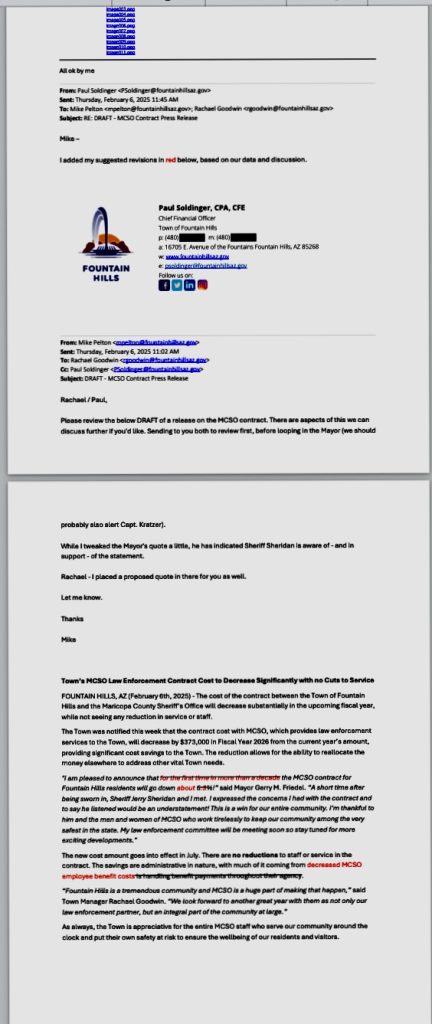
The statement was carefully crafted to imply but not directly state that Friedel’s meeting with the sheriff resulted in the MCSO’s decision to charge fountain Hills $370,000 less for police services.
The inclusion of the phrase ‘to say he [Sheridan] listened would be an understatement!’ clearly implies that after hearing Friedel’s concerns, the Sheriff agreed to give Fountain Hills a discount. Clearly, that is what many of Friedel’s supporters believed. Following the announcement, he was showered with praise.
In a post, now deleted, Councilmember Hannah Toth boasted that, in a few short months the “conservatives” had saved Fountain Hills taxpayers “almost a million”.
Friedel claims direct credit for the “savings”
Toward the end of a letter to the editor, published on February 21st, Friedel took direct credit for the reduction.
Opinion
Confusion over MCSO contract savings in Fountain Hills
Posted Friday, February 21, 2025 10:42 am
By Gerry Friedel | Mayor, Town of Fountain Hills
My meetings with Sheriff Jerry Sheridan resulted in year-over-year savings of 6%, or approximately $370,000. The new contract is the first MCSO contract savings in decades.
If Gerry’s initial statement was circumspect, leaving room for plausible deniability, the statement he made in the February 21st letter to the editor was not. This statement, directly linking Friedel’s meetings with Sheridan to the reduction, left no room for interpretation or plausible deniability. The statement was a blatant misrepresentation and there is a contract and a letter to prove it.
The cost reduction was the result of events that predated Friedel’s meetings with Sheriff Sheridan
MCSO’s Law Enforcement Services Agreement with Fountain Hills, and other municipalities that contract for its services, is based on a “cost recovery” model. Essentially, the MCSO recovers the direct costs it incurs in providing law enforcement services and assesses an additional 3% to recover its indirect administrative costs.
In the contract, municipalities agree to reimburse the MCSO as detailed in annualized worksheets for the fiscal year (See, MCSO Agreement Section III. A. 1) The total amount paid under the contract on a fiscal year basis is subject to a 3% administrative service charge “to help recover a portion of the administrative support costs” (III. D.6)
The reimbursement costs under the agreement are reviewed and revised annually. (III. B.) The MCSO agrees that no later than Februrary 20 of the preceding fiscal year, it will provide the town manager with the calculated annualized amount to be paid for the upcoming fiscal year. (III.B.1).
On February 5, 2025, the MCSO fulfilled its obligation to communicate its calculations and the resulting annualized adjustment to Fountain Hills. The letter from Mr. Prindiville begins with the following two paragraphs:
“Enclosed, per Section III.A.2.a. of the Law Enforcement Services Agreement between the Town of Fountain Hills and Maricopa County on behalf of the Sheriff’s Office, is the updated Worksheet (Exhibit A) with Law Enforcement charges for FY 2026, effective July 1, 2025. “
The FY 2026 cost is $5,759,468.37. This a net decrease of $373,243.21 (6.09%) from the current year. “
The explanation for the reduction was provided on page 2 of the letter in the following paragraph:
“In 2023, the Maricopa County Board of Supervisors took advantage of low interest rates to pay down unfunded pension liabilities, directing $500 million into the Public Safety Personnel Retirement System (PSPRS) and Corrections Officer Retirement Plan (CORP). This is the first year of reduced pension contribution rates, and they are reflected in the lower benefits rate applied to sworn deputy compensation. “
The reduction had no connection to and certainly did not result from Friedel’s meetings with Sheriff Sheridan. We do not doubt that a meeting or meetings were held where Friedel expressed his concerns to the Sheriff. But the Sheriff did not respond to Friedel’s concerns by cutting him a deal to knock 6% off the amount Fountain Hills would be required to pay during the next fiscal year.
As evidenced by the letter from Mr. Prindiville, pictured above, the events that led to the reduction had been in the works years before the mayor and the sheriff met. In 2023, the Maricopa County Board of Supervisors decided to pay down the County’s unfunded pension liabilities under the Arizona Public Safety Personnel Retirement System. This “pay down” resulted in lower personnel costs for MCSO and a corresponding cost reduction for Fountain Hills and other municipalities (including Carefree and Cave Creek) it serves. The reduction was also attributed to vacancy credits, negotiated into the contract during Mayor Dickey’s administration, resulting at the time, in a $722,000 reduction. Notably, but not surprisingly, Mayor Dickey never attempted to take credit for this considerably more significant “reduction”.
Friedel attempts to walk back his claim
It appears that Friedel’s unambiguous and unsupported claim that his meetings with the sheriff resulted in the reduction concerned either Sheridan or other MCSO officials. After the letter to the editor was published, Friedel attempted to walk back his statement, through a “Friedel Friday” that was not published on his official page but to a large, private Facebook Group, known for blocking and banishing Friedel’s critics. In this post Friedel stated: “Let me be clear this [the 6% reduction] has nothing to do with me…”

Friedel’s ultimate admission that he had nothing to do with the 6% reduction was too little -too late. Based on the comments accompanying the post, Friedel’s supporters viewed this statement not as an admission that he had not told them the truth in his initial statements, but as evidence of his humility, a humble man’s reluctance to take credit where credit was due.
A hollow promise of “transparency”
Toward the conclusion of the letter to the editor, Friedel wrote: “I will always be transparent to the residents of Fountain Hills.”
In retrospect, Friedel’s choice of the preposition “to” as opposed to “with” is both significant and ironic. Friedel is transparent to those residents who can see through his inartful attempts at deception, but Friedel has not been transparent with any of us.
Prop 312 and the Homeless

Photo source: American Psychological Association, “Laws banning sleeping outdoors criminalize homelessness,” Oct.1, 2024
FOR THOSE WITHOUT SHELTER WINTER IS COMING
It has been estimated that each year approximately 5 million U.S. residents lose their housing because they can no longer afford it, resulting in evictions and foreclosures. For the majority, this will be there first experience with homelessness, and most are able to find shelter with the help and support of friends, family, government, and private social service agencies. But the demand for housing exceeds the supply, and those who cannot find shelter or due to mental illness or addiction, are incapable of locating it, find themselves living on the streets.
Despite the best efforts of Allen Skillicorn and other alarmists, to convince us otherwise, the reasonable residents of Fountain Hills recognize that, with very few exceptions, those who live in or pass through our town can go to sleep every night with a roof over their heads. That is not the case in many other towns and cities in Maricopa County or the United States.
The Maricopa County Association of Governments (“MAG”) participates in the Continuum of Care program (“CoC”), a national community focused approach to ending homelessness. Since 1999 MAG has provided staffing and financial support to the Maricopa County CoC.
Each year the CoC conducts a survey to identify the number of people who are without housing or living in shelters on a single day – the “point in time”. Shelter outreach teams and volunteers participate in this effort. The results of the survey are analyzed to determine what, if any, progress has been made in reducing the number of people who are unhoused; how to allocate existing resources; and what additional resources are needed.
According to the Point in Time (“PIT”) survey conducted on Jan. 22, 2024, there were 4,076 residents of Maricopa County who were without housing, a 17 percent decrease from the prior year. On that same date, there were 5,359 people in emergency shelters or transitional housing, a 13 percent increase from the prior year. According to the national PIT report, on Jan. 21, 2024, 653,104 people were without shelter, a 12 percent increase from the prior year.
Is a crackdown coming?
Until recently, local governments were reluctant to attempt to curb homelessness by imposing criminal penalties based, in part, on the belief that it would be unconstitutional. This belief was based on case law, like the Ninth Circuit’s decision in Martin v. Boise, where the court found that imposing criminal penalties on individuals without shelter violated the Eighth Amendment’s prohibition against cruel and unusual punishment. According to the Ninth Circuit, “as long as there is no option of sleeping indoors, the government cannot criminalize indigent, homeless people for sleeping outdoors, on public property, on the false premise they had a choice in the matter.”
Local governments no longer need to be concerned with constitutional constraints on their power to punish the homeless for the crime of sleeping on the streets. In July of this year the United States Supreme Court issued its ruling in the case of Grants Pass v. Johnson. The Supreme Court found that laws, regulations and ordinances that ban sleeping or camping on public property and impose criminal penalties on individuals who violate the bans do not violate the Eighth Amendment.
Last year, in the aftermath of the controversy, sparked by Councilmember Skillicorn’s relentless fear mongering, the Fountain Hills Town Council enacted an ordinance (11-3-2 ) that makes it unlawful for an individual to use a public street, alley, lane, parkway, or other right of way to lie down, sleep, or remain in a sitting position. The Town Council also enacted an ordinance (11-3-3) that prohibits camping in any public park or place except where specifically authorized. Section 11-3-4 of the Town Code provides that individual violators will be subject to civil penalties as provided in Article 1-8: fines ranging from $250 to $2,500 depending on the number of infractions. Criminal sanctions can also be imposed on “habitual offenders.” The Town Code currently provides that civil and criminal penalties can be avoided if the person consents to be taken to a facility providing social services related to “mental health, housing, and/or substance abuse.” The Town Council determined that it would partner with local social service agencies to provide emergency and transitional housing.
It is important to note that Arizona is in the Ninth Circuit and until the Supreme Court’s recent decision, local and state governments were bound by that court’s determination that criminal penalties could not be imposed for the violation of bans on outdoor sleeping and camping if there was no alternative housing provided. Now that the constitutional constraint has been lifted it remains to be seen whether local governments will begin issuing tickets, imposing fines, and jailing the most vulnerable members of our community. We feel confident that at least one Town Councilmember will be eager to “lock them all up.” Hopefully, the majority of the Town Council will reject that option.
Public officials more interested in the welfare of the community than grandstanding will not support a crackdown. Both compassion and common-sense weigh heavily in favor of rejecting a crackdown. There is irrefutable evidence that issuing a ticket to or assessing a fine against a person with no resources does not curb homelessness. It has been established that the homeless who are cited rarely show up for court appearances and have no money to pay the resulting fines. In addition, a crackdown would be fiscally irresponsible.
A crackdown would divert administrative, police, and court resources at considerable expense to taxpayers. Arresting and jailing those who do not comply is an extraordinarily expensive exercise in futility. Four years ago, the cost of booking and jailing a person for a single day in Maricopa County was $500.
We do not need more people in Arizona jails. The increase in Arizona’s prison population during the past two decades is more than double the increase in the state’s general population.
Will local governments feel compelled by Proposition 312 to stage a crackdown?
Despite the evidence that punitive laws and ordinances targeting the homeless are both ineffectual and expensive, local governments may believe that they have been placed between a rock and hard place by Proposition 312.
In November, Arizona voters approved the proposition, which calls for the amendment state law to authorize the owners of private property to receive property tax refunds for amounts they incur for “private mitigation efforts” if it is determined that their local government has not taken sufficient action to curb homelessness by enforcing laws outlawing “camping, blocking roads, panhandling, or urinating and defecating in public.” Private mitigation efforts include the cost of installing and operating security cameras, hiring private security, and cleaning up the property.
The irony of Proposition 312 is that it threatens to make it impossible for local governments to pursue the only remedy found to effectively address all the maladies associated with homelessness: housing. To avoid the expense of litigation with disgruntled residents and the loss of property tax revenue, local governments may feel compelled to aggressively enforce existing bans. Revenue will be diverted to enforcement, the enforcement will fail, and the property tax revenue will still be forfeited when property owners establish that people are still living on the streets.
Compassionate and prudent local legislators could respond to this dilemma by rescinding their punitive ordinances and allocating funds to work with social service agencies and community volunteers to provide housing and treatment for those who need it. But that is unlikely to happen in our current political climate where compassion is viewed as a liberal conceit. The alternative is the one adopted by a majority of the Fountain Hills Town Council last year: Give the “violators” the opportunity to avoid civil or criminal penalties if they consent to be taken to a facility providing social services related to “mental health, housing and/or substance abuse.”
WHAT CAN WE DO?
Volunteer to Help with the PIT Count
The CoC relies on the data collected during the annual PIT survey to identify the needs of the unhoused in our community and how to best allocate resources to address those needs. This work is essential to our ability to understand and address the scope of the challenge in our community.
This year the PIT count is scheduled for January 28, 2025. Justin Weldy is the volunteer coordinator for Fountain Hills. Please consider volunteering to assist in the process by contacting Mr. Weldy at: jweldy@fountainhillsaz.gov.
Let the Mayor and Town Council know that you are opposed to a “crackdown”.
We can only hope that the recently elected council will resist the urge to participate in a crackdown and continue to follow the common-sense approach to addressing one of our society’s most intractable problems. However, we need to monitor the current council and be prepared to communicate our opposition to ordinances or resolutions that would punish the homeless in our community.
Be watchful for and generous to the unhoused.
As you travel through our Town keep an eye out for those in need. If you can do so safely, approach them, introduce yourself and ask if there is something you can do for them.
The congregation of The Fountains United Methodist Church (15300 N Fountain Hills Blvd.) has prepared “Blessings Bags” to distribute to those in need. Each bag contains a simple meal, energy bar, water, toiletries, socks and underwear. The bags are kept on tables in the Church vestibule. You can pick up a bag or bags from the church or make your own to carry in the trunk of your car.
You can also help those you encounter who appear to be without shelter by directing them to available community resources.
Fountain Hills has a contract with Central Arizona Shelter Services (“CASS”) to provide housing to single adults experiencing homelessness in our town. The individual must be referred for these services by a designated representative of the Town or the MCSO. To obtain basic information about CASS services and their programs by calling 602-256-6945. In the alternative, to connect a deputy with the person in need call the MCSO non-emergency number 602-876-1011. Where appropriate the deputy can present options, arrange transportation and contact CASS on behalf of the Town.
New Leaf is another local resource for the unhoused. The telephone number for New Leaf Centralized Services is 877-211-866. The number for Family Housing that may be available through New Leaf is 602-595-8700.
Consider programming these numbers into your phone and writing them on post it notes to carry with you or include in the Essentials Bags you distribute.
Winter is coming and we need to do what we can to help those in need get through it safely
No, There Was Not an “Investigation” That Could Have Bankrupted Fountain Hills Friedel’s Outrageous Lie Puts Future of Fountain Hills at Risk
On October 2, 2024, Gerry Friedel issued a statement demonstrating, beyond question, that he will lie to win the mayoral election, even if the lie risks the financial reputation and future of Fountain Hills.
The lie, contained in a “press release” provided to a number of media outlets, including the Fountains Hills Times and the Arizona Free News, addressed the Town Council’s failure to appoint Gayle Earle to fill the seat vacated by Councilmember Grzybowski. The press release included many false statements of fact and law, but by far the most outrageous was the claim that due to Mayor Dickey’s alleged statutory violation and the resulting complaint filed with the Attorney General, the “State Treasurer will be required to hold back the shared state funds for the town, effectively bankrupting Fountain Hills until the complaint is resolved.”
This statement was a complete fabrication intended to alarm the public and turn them against Mayor Dickey on the eve of the election.
As set out below, under the applicable statutes, the State Treasurer had no authority to withhold funds from Fountain Hills during an investigation into the claim that Mayor Dickey violated state law.
Nine days after Friedel made this statement the Attorney General’s office determined that it did not have the statutory authority to investigate; however, even if an investigation had been undertaken and the Attorney General determined that the law had been violated, no funds could be withheld by the State Treasurer unless the Town failed to correct the violation within 30 days after it was advised of the determination. In addition, even if the violation was not corrected within the 30-day “grace period,” under no circumstances could the State Treasurer withhold funds needed by the Town to service its debt or meet its ongoing financial obligations.
There was never any risk that that the Town of Fountain Hills would be “bankrupted” by the decision not to fill a vacancy 30 days before the scheduled election.
Never one to shrink away from rebroadcasting a lie, Allen Skillicorn, the Town’s self-appointed Chaos Agent, apparently working in concert with Friedel, used his best efforts to ensure that the lie was widely disseminated:
Three weeks after the lie was published, it has been conclusively determined that there will be no investigation, no finding of a statutory violation, and no funds withheld from the Town by the State Treasurer that could “bankrupt” Fountain Hills. Yet to date, neither Friedel nor Skillicorn have issued a statement advising the public that there will be no investigation and there is not (and never was) any risk that state funds would be withheld that could bankrupt Fountain Hills.
Why do they continue to perpetuate this lie?
The Facts
The Vote
Effective Sept. 5, 2024, Councilmember Sharron Grzybowski resigned her seat on the Town Council. Grzybowski’s seat, along with one other, would be filled on December 3, 2024, following the results of the November election. If the Town Council did not appoint a replacement in the interim, the seat would remain vacant for a total of four regularly scheduled meetings.
During its September 17 meeting the Town Council considered Councilmember Skillicorn’s request that it appoint Gayle Earle to fill the vacant seat. Prior to and during the meeting the Council received public comments on the issue of whether Earle should be appointed to the seat. Approximately 90 percent of the comments, submitted in writing and in person, favored leaving the seat vacant. The vote on Councilmember Toth’s motion to appoint Earle resulted in a 3-3 split. Earle was not appointed.
The “1487 Complaint”
In 2016, the Arizona Legislature enacted SB 148. The Act empowers any member of the state legislature to submit a complaint to the Attorney General if he or she believes that a local government entity or agency has taken an action that violates Arizona state law or the Arizona Constitution. The letters submitted by legislators advising the Attorney General of suspected violations are referred to as “1487 Complaints.” The governing provisions are found in A.R.S 41-194.01.
Under § 41-194.01, if the complaint falls with the purview of the statute, the Attorney General has 30 days to complete its investigation and issue a determination as to whether or not state law had been violated. If the Attorney General determines that there has been a violation, the local government entity or agency has 30 days to take corrective action. If, at the conclusion of that 30-day period, corrective action has not been taken, the Attorney General is directed to notify the State Treasurer to withhold “shared monies” from offending entity or agency until the corrective action is taken. Significantly, the State Treasurer cannot withhold funds needed by the local government “to make required deposits payments for debt service on bonds or other long-term obligations.” A.R.S. § 42-5029, subsection L. This prohibition serves as a safety net, effectively protecting the local government entity or agency from defaulting on its obligations and risking insolvency.
On Sept. 30, 2024, State Representatives Alexander Kolodin and Joseph Chaplik submitted a “1487 Complaint” to the Arizona Attorney General’s Office. The letter provided:
Dear Ms. Crawford:
When a vacancy occurred on the Fountain Hills Town Council (the “Council”) it deadlocked with respect to filling the vacancy via vote on 9/17/2024. The council has not agendized the filling of the vacancy for October. As a consequence, it does not appear that the Town Council will ever fill this vacancy, as it is compelled to do by law, but will simply wait until the winner of the election takes office.
A.R.S. § 9-235, however, states: “The council shall fill a vacancy that may occur[.]” Accordingly, the council has no discretion to wait until the voters fill the vacancy but, rather is required to fill the vacancy itself pending the voters’ chosen candidate taking office.
Therefore, pursuant to A.R.S § 41-194.0I, I (sic) am requesting that your office investigate whether the Fountain Hills Town Council is in violation of A.R.S § 9-235.
The complaint, asked the AG to investigate whether or not Mayor Dickey violated § 9-235 when, following the split vote, she did not place the issue of Earle’s appointment on the agenda for either or the two meetings scheduled to occur before the November 5 election.
The complaint was fatally flawed for two reasons:
First, under §41-194.01, the Attorney General only has the authority to investigate complaints resulting from the alleged violation of state law or the Arizona Constitution by the enactment of an “ordinance, regulation, order or other official action” or the adoption of a “written policy, written rule or written regulation” that violates state law or the Constitution of Arizona. Here, the complaint was not based on any affirmative legislative action or any written policy.
On Oct. 11, 2024, Hayleigh Crawford advised Kolodin and Chaplik that there would be no investigation into their complaint because their allegations of “misconduct” did not involve any affirmative action that fell within the purview of §41-194.01.
In addition, the Town Council’s failure to fill the vacant seat did not violate state law. Section 9-235 authorizes and obligates a Town Council to fill a vacancy by appointment, but does not state when the appointment must be made. The statute does not require that the position be filled at the next regularly scheduled meeting or within a specific number of days. Where, as here, a statute does not specify a time frame for completing an action, it is presumed that the legislature intended to provide a “reasonable period.”
This presumption of a reasonable period to fill the vacancy is consistent with the following relevant provisions of the Fountain Hills Town Code:
2-1-4 Vacancies in Town Council
A. The Council shall fill any vacancy that may occur in the Council by any method provided by ARIZ.REV.STAT. 9-235.
C. All vacancies shall be filled in a reasonable time from the occurrence of the vacancy.
The only method for filling a vacancy provided under §9-235 is appointment by the Town Council. The Mayor does not have the authority to fill the vacancy through appointment. The Council has a “reasonable time” to fill the vacancy.
An effort was undertaken to fill the seat within two weeks after the vacancy occurred. That effort failed. It was not unreasonable for the Mayor to await the outcome of the election when it was clear that the majority of the Town Council would not vote to appoint Earle.
Friedel’s Lies
Two days after the 1487 Complaint was sent to the AG, Friedel issued a “press release” that received a brief mention in the Fountain Hills Times but served as the basis for a full blown, error-laded article published by the Arizona Free Press. The article included the following sentence: “Fountain Hills Town Councilman and Republican Mayoral Candidate Gerry Friedel revealed on Tuesday that Democrat incumbent Mayor Ginny Dickey has refused to appoint primary election winner Republican Gayle Earle to the council.” The article continues: “In so refusing Dickey preserves a 3-3 partisan deadlock until after the November election but is accused of violating state law.”
Friedel was clearly aware that Mayor Dickey had no power to appoint Earle. Yet, he deliberately represented that the Mayor had the authority to appoint Earle and refused to do so because Earle was a Republican.
The article concluded with the following quoted statement, attributed to the Friedel Campaign: “The AG will investigate Mayor Dickey’s unwillingness to agendize filling the vacancy while the State Treasurer will be required to hold back the shared state funds for the town, effectively bankrupting Fountain Hills until the complaint is resolved.”
As set out above, this statement was a lie. The State Treasurer could not withhold state funds while the matter was under investigation. The State Treasurer could withhold funds only after the investigation resulted in a determination that there had been a violation covered by the statute and then only if the Town failed to correct the violation within 30 days. In no event could the State Treasurer withhold funds necessary for the Town to meet its debt obligations.
There was never any risk that that the Town of Fountain Hills would be “bankrupted” by the decision not to fill a vacancy 30 days before a scheduled election. So why did Friedel lie?
Even those who have grown accustomed to Friedel’s dirty campaign were surprised that he would sink to this level. This lie is remarkable both for its unbridled mendacity and for its potential for causing lasting injury to Fountain Hills.
Did Friedel even consider how current, or prospective creditors or contractors, would react to a sitting member of the Town Council’s statement that the Town would be effectively bankrupted by the Mayor’s alleged unlawful act? Did he consider how current or prospective residents or business owners would respond?
The questions we need to ask Friedel at this point are:
Now that the lie has been exposed, will you retract your statement?
Will you apologize to the residents for creating an unwarranted concern for the solvency of our Town?
We are waiting.
Join Our Newsletter
Sign up to receive updates.