
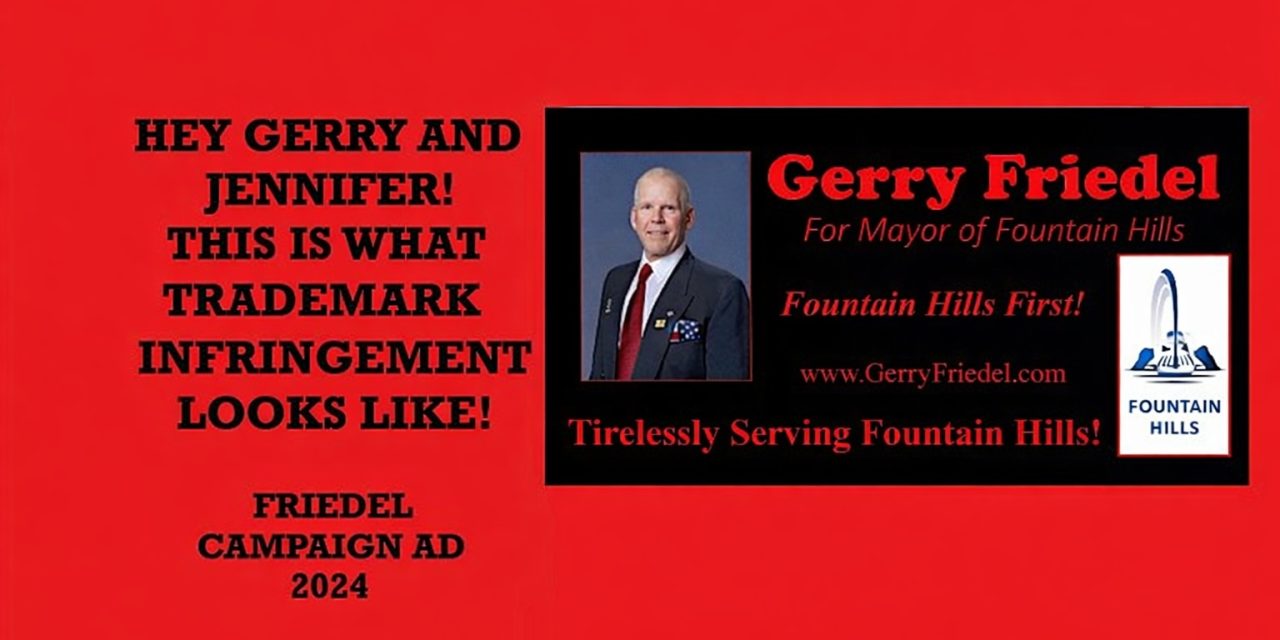
With all of the Notices of Claim and Open Meeting Law complaints pending against the Town of Fountain Hills arising out of the unconstitutional acts of the Town Council, the Park Place debacle, and Jennifer Wright’s ineptitude, you would think that the last thing she and Gerry Friedel would be looking for is more litigation. And yet, they appear to be doing just that. On March 10, Wright, who appears to be as clueless about intellectual property law as she is about municipal governance, issued a “cease and desist” letter, threatening to sue Council candidates for their purported unlawful use of the Town seal and logo in their campaigns.
In that letter, Wright warned candidates that if they use an image that is “substantially similar” to either the Town’s seal or logo, “their continued use on campaign materials may result in legal action.”
Both the Town seal and logo incorporate graphic images of the Town’s iconic fountain. Currently, two candidates for Town Council, Ben Larrabee and Catherine Mirick, have incorporated graphic images of a fountain into their campaign ads. Neither of these images could be confused with the Town Seal or the Town logo. But the Council candidates are not the target.

With this “shot across the bow,” Friedel and Wright hope to intimidate Brenda Kaliviankis, Friedel’s opponent, with the threat of litigation that would generate negative publicity for her campaign and force her to incur the cost of revising and reissuing her campaign ads and literature.
The Kalivianakis logo bears no similarity to the one-dimensional Town seal. The Town logo is a stylized, multicolored graphic featuring a sun and mountains behind the silhouette of a fountain. The Kalivianakis logo uses variations of red, white, and blue and does not include the sun or the mountains. The logo does, however, incorporate a minimalist outline of the base of the fountain like that found in the Town’s logo, but with a significant difference in the spray, which in the Kalivianakis logo spills to form the letter ”K.”
The town can trademark its specific artistic rendition of the fountain, but to succeed in an infringement claim the replication must be exact. More importantly, trademark law is designed abd intended to prevent”consumer confusion.” Here, to prevail the Town would need to prove that a reasonable voter looking at the Kalivianakis logo would believe that the Town is officially endorsing her candidacy. Is that likely?
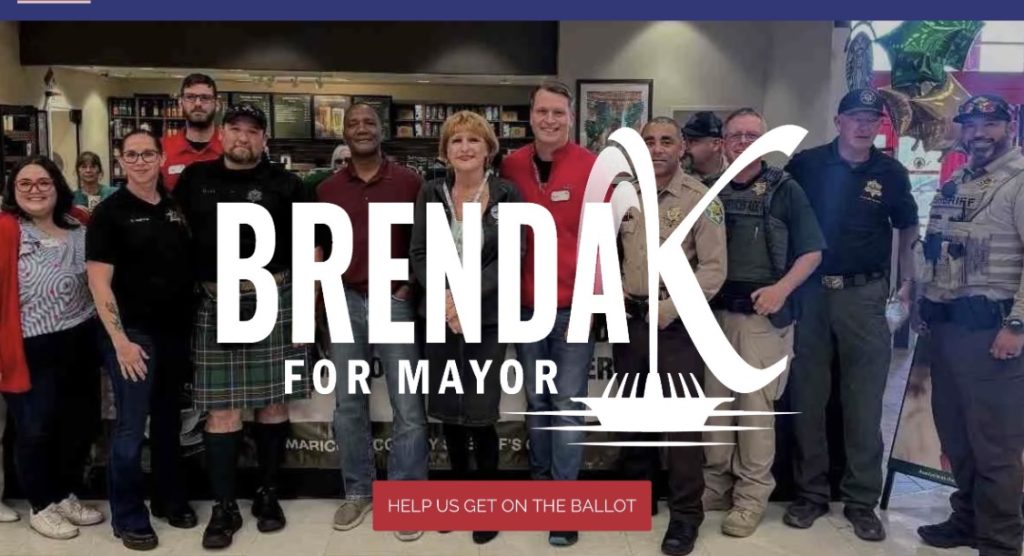
The First Amendment prohibits public bodies and government officials from using trademark law to suppress the speech of political challengers. This act of sending a cease-and-desist letter to the mayor’s opponent during a campaign is likely to be viewed by a court as a strategic move designed to further Friedel’s political goals by forcing his opponent to spend money on new signs and flyers and create negative publicity for her. Think, “Fountain Hills sues Kalivianakis for stealing the Town’s logo”!
This strategy is likely to backfire on both Wright and Friedel by again, casting the spotlight on their cozy relationship . The public is not likely to look favorably on the use of public funds to pursue and intimidate the mayor’s political rival. To do so would violate A.R.S. § 9-500.14, which prohibits the use of Town resources (including staff time) to influence the outcome of an election.
If she pursues this matter Wrightis also inviting an ethics complaint. As a sitting councilwoman, Kalivianakis is a “constituent member” of Wright’s client, the Town of Fountain Hills. Threatening litigation against a councilmember, to benefit a political ally, creates a significant ethical conflict.
Could the Town succeed in an infringement claim against Kalivianakis? Probably not. A court is not likely to find that the Kalivianakis logo would lead anyone to believe that the Town of Fountain Hills is backing her bid to succeed Friedel.
But without regard to the merits of the trademark infringement claim, the question residents should be asking ask is: “How would the threatened litigation serve our interests?”
Litigation brought against Kalivianakis is likely to be met by a counterclaim against Friedel and the Town. In all likelihood Kalivianakis has personal liability coverage that would pay for her legal defense. In contrast, the amount paid to retain trademark counsel to issue a formal opinion, draft a complaint, and pursue litigation would come directly out of the Town’s budget: our tax dollars.
Will Friedel and Wright stand down? Probably not. But if they cared more about the interests of residents than they do about Friedel’s reelection, they would.
