
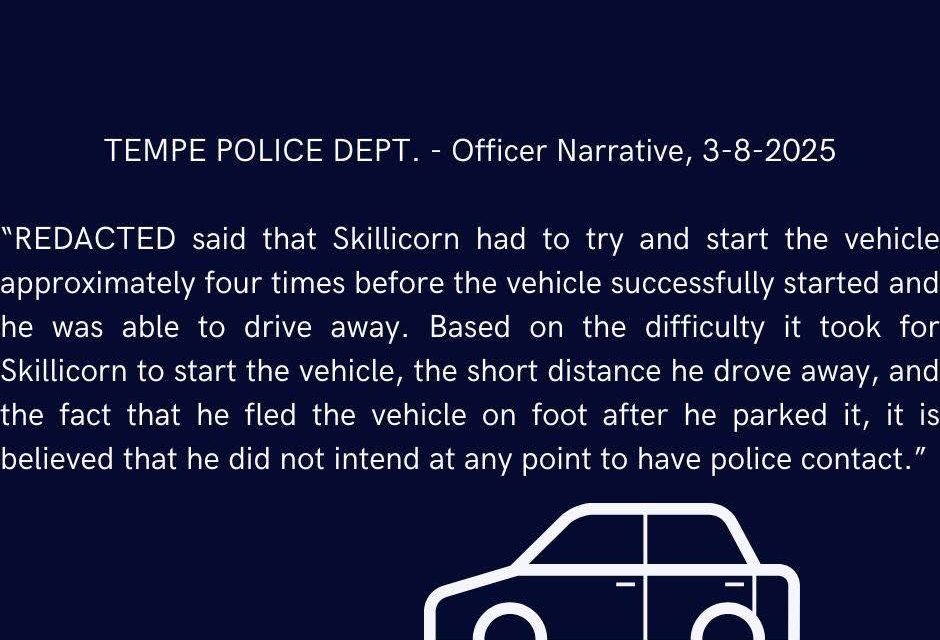
Cavanaugh’s call for apologies ignores what Skillicorn’s own “Fake Charges” video proves—that he broke the law.
During the November 4 Town Council meeting, ROT’s Chairperson, Crystal Cavanaugh, once again took to the lectern to make it clear that she has no intention of relinquishing her position as the Town Scold and chief purveyor of disinformation. Again, Cavanaugh took it upon herself to express her most profound displeasure with those who dare to question Allen Skillicorn’s character of ROT’s candidate, or accurately report on his unlawful and unethical conduct.
On this occasion Cavanaugh took it upon herself to again lambast Councilmember Kalivianakis for the following comment she made to the Arizona Republic after the criminal hit-and-run charges against him first surfaced:
“Allen refuses to take responsibility for Allen’s actions, the fact that he would flee an accident scene fits right in line with other things I have noticed about his character.”
Cavanaugh also repeated her condemnations of the Fountain Hills Times Independent for accurately reporting on the facts of the incident as detailed in the records of the Tempe police report.
Straining mightily to inject every word with venom and outrage, Cavanaugh claimed that Skillicorn had been vindicated by the plea agreement negotiated by his lawyer with the Tempe prosecutor. Based on the plea deal that dismissed two charges but required Skillicorn to plead guilty to a lesser “excessive speed” charge, Cavanaugh demanded that Kalivianakis, the Fountain Hills Times, and certain unidentified members of the public issue an apology to Skillicorn.
Skillicorn is not owed an apology where the video evidence he himself recently published on Rumble establishes that on March 5, 2025, he violated A.R.S. § 28-662(A)(1), which provides:
A. The driver of a vehicle involved in an accident on public or private property resulting only in damage to a vehicle that is driven or attended by a person shall:
1. Immediately stop the vehicle at the scene of the accident or as close to the accident scene as possible but shall immediately return to the accident scene.
Within days of the plea agreement, Skillicorn posted a video on the Rumble site titled “Fake Charges Dismissed.” The video begins with Skillicorn’s self-serving and potentially libelous narrative, where he claims that he was vindicated by the plea agreement and accuses the other driver of lying and causing the accident.
The surveillance video, obtained by the other driver’s father and downloaded into the evidence file, shows Skillicorn and the other driver entering a parking lot where they had moved their cars, presumably to avoid obstructing traffic on University Avenue, the site of the accident. After meeting for approximately seven minutes Skillicorn entered his vehicle, and after struggling to start it drove slowly out of the parking lot. Another surveillance video, not featured in Skillicorn’s “Fake Charges” post, established that after leaving the parking lot, Skillicorn drove approximately three blocks where he abandoned his vehicle in a parking lot behind the Tempe MAACO.
Ironically, Skillicorn’s “Fake Charges” video stands as irrefutable proof that he committed the criminal act of failing to return to the scene of an accident. Far from exonerating him, the video establishes that Skillicorn violated A.R.S. § 28-662 when he failed to return to the scene of the accident. The statute provides that a driver involved in a collision involving property damage must immediately stop the vehicle at the scene or as close to the scene as possible. Although driving to an adjacent parking lot is permitted to avoid obstructing traffic, the statute expressly provides that after moving their vehicles to another location, the involved drivers “shall immediately return to the accident scene” to allow for the investigation of the collision and an assessment of fault. Skillicorn did not immediately return to the accident scene on University Avenue as required by law and subsequently ignored five telephone calls made to him by a Tempe police officer demanding that he immediately return to the scene.
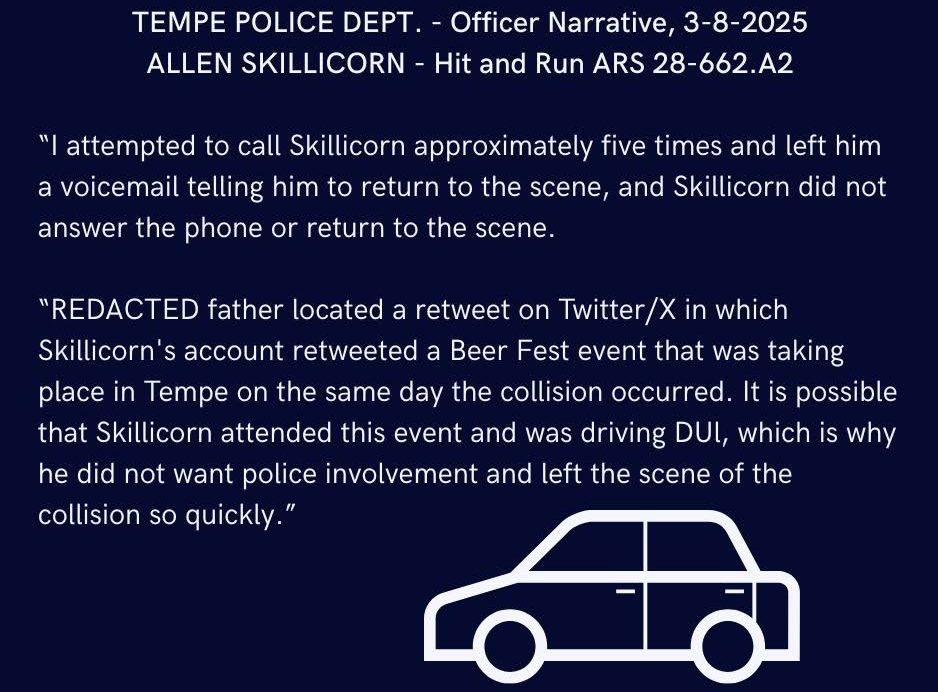
Rather than return to the accident scene, Skillicorn found an obscure location where he could abandon his vehicle and avoid interaction with the investigating officers who had been summoned to the scene.
In his video narrative, Skillicorn makes no attempt to explain or justify his failure to return to the scene of the accident when he and the other driver could easily walk back to the accident site and wait for police to arrive. Skillicorn offers no explanation for his failure to follow or even respond to the telephone calls made to him by the investigating officer to return to the scene of the accident. The obvious question is, “why” would he risk criminal liability for failing to return to the scene? What was he afraid of?
In addition to the charge of failing to return to the scene of an accident, Skillicorn was charged with leaving the scene before failure to provide the information required by A.R.S. § 28-663.
In the “Fake Charges” video Skillicorn claims that during his brief encounter with the other driver, he met his obligation to provide the information required by the statute, which includes the vehicle’s registration and his name, address, and telephone. Although the other driver told the police that he and Skillicorn exchanged telephone numbers in the parking lot, Skillicorn did not provide him with his name or address until approximately 15 minutes later, by texting a copy of his driver’s license. There is no evidence that Skillicorn provided his vehicle’s registration before leaving the scene. According to the police report, days after the accident Skillicorn still had not provided the vehicle’s registration.
In the “Fake Charges” video Skillicorn, while coyly dangling his iPhone in front of the camera, claims that the phone contains evidence that he did provide the other driver with the required information before driving away. Skillicorn did not share this evidence with the video’s viewers.
In the “Fake Charges” video Skillicorn also blames the other driver for the accident, claiming that he “didn’t even look” before pulling onto University Avenue. Skillicorn goes on to claim that immediately following the accident the other driver acknowledged fault and apologized, but then suddenly changed his story and “lied.”
Although a driver entering a roadway who fails to yield to oncoming traffic resulting in a collision is presumed to be at fault under A.R.S. § 28-773(A), this presumption does not apply if the driver of the other vehicle is found to have been driving at an unlawful or excessive speed. See, Layne v. Hartung, 90 Ariz. 369 (1962). Although a driver with the right-of-way is ordinarily protected, that right is not absolute.
If a driver’s excessive speed prevents another motorist from accurately judging their approach, the speeding driver loses the benefit of the right-of-way rule. The fact that Skillicorn pleaded guilty to traveling at excessive speed in violation of A.R.S. § 28-701(A) is compelling evidence that he, and not the other driver, was at fault.
The dismissal of the criminal charges does not support Cavanaugh’s or Skillicorn’s proposition that he was vindicated by the plea agreement. The court records indicate the dismissals were without prejudice to refile them.
Under Rule 16.4 of the Arizona Rules of Criminal Procedure, a docket entry stating only that a charge was dismissed is presumed to mean that that the criminal charges were dismissed without prejudice, preserving the prosecutor’s right to refile the charges if warranted by subsequent events.
Skillicorn’s video might be a subsequent event that could prompt a prosecutor to refile the charges to establish that they were not, as he claims, “fake.” Skillicorn would be well advised to take down the “Fake Charges” video and avoid any further charges for excessive speed or reckless driving. He has not been vindicated and no one owes him an apology.
