
On November 17, the national controversy over Flock cameras is coming to Town Hall, thanks to none other than Allen Skillicorn who, in what is (hopefully) his final futile attempt to gain political relevance and stir the pot by sponsoring unnecessary and often nonsensical resolutions and ordinances, will champion proposed Ordinance 26-17. The ordinance would impose a sweeping prohibition on automated license plate readers, commonly known as Flock cameras, and any other devices that use comparable vehicle-identification technology.
It is of no moment that Fountain Hills currently has no Flock cameras on public property or rights-of-way, nor that MCSO has evidenced no interest in adopting the technology to support its law enforcement efforts.
Skillicorn is intent on making headlines in the conservative press by enacting a preemptive ban on this technology, which, for members of the far right, represents another insidious effort by the deep state to spy on them by tracking and recording their every movement.
 The Shadow Mayor
Skillicorn is not alone in viewing the immediate enactment of the ban as a matter of utmost urgency. He has an ally: Larry Meyers, the Treasurer of Reclaim Our Town (“ROT”), also known as the Shadow Mayor.
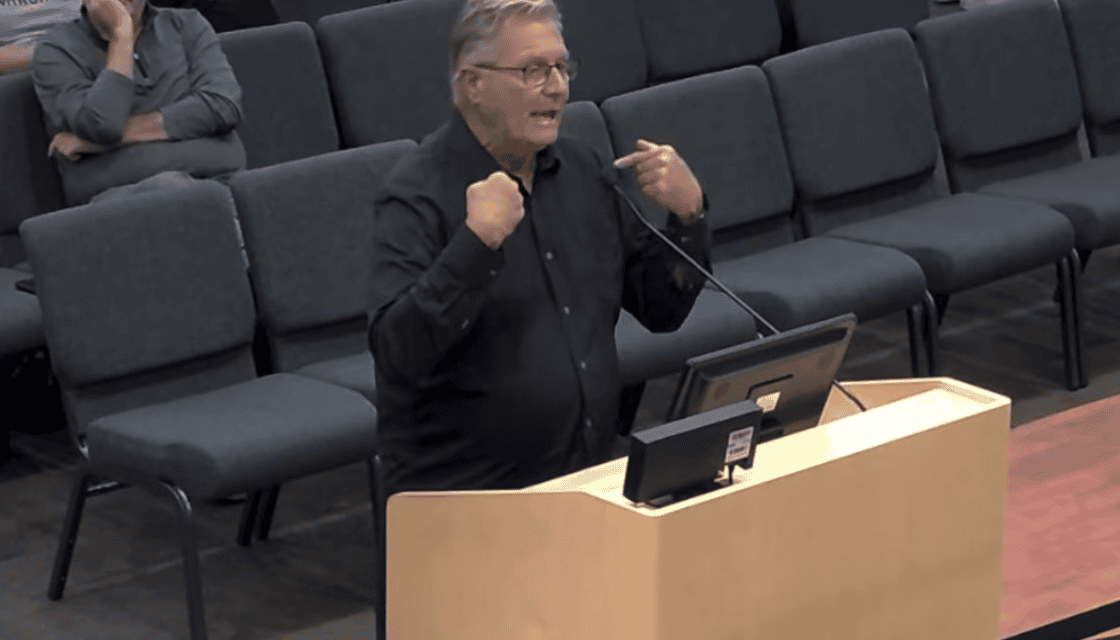
During the prior Council meeting, when the Flock ban was on the agenda for discussion, Meyers spent a full three minutes and 38 seconds lambasting the Council. The Shadow Mayor made it clear that he supported the ban “as written” and was “personally offended” that the proposal had not been placed on the agenda for a final vote.
During his tirade, Meyers ridiculed Councilmembers McMahon, Kalivianakis, and Watts, who expressed concerns about enacting a ban before the Council had adequately considered the issue. Councilwoman Kalivianakis questioned the necessity of prohibiting a technology that Fountain Hills does not currently use without first obtaining a comprehensive assessment of its potential benefits, risks, or available safeguards. Councilwoman McMahon and Councilman Watts both expressed a desire to seek input from MCSO before voting on the measure.
But Meyers was having none of that. He doesn’t care what MCSO has to say and scoffed at the idea of a “work session.”
It is hardly surprising that, after hearing Meyers’ unequivocal direction, Friedel meekly dismissed the concerns of his colleagues and stated that the measure would be on the agenda for the next meeting. After all, he and the other members of the ROT majority are beholden to Meyers, and they know it.
